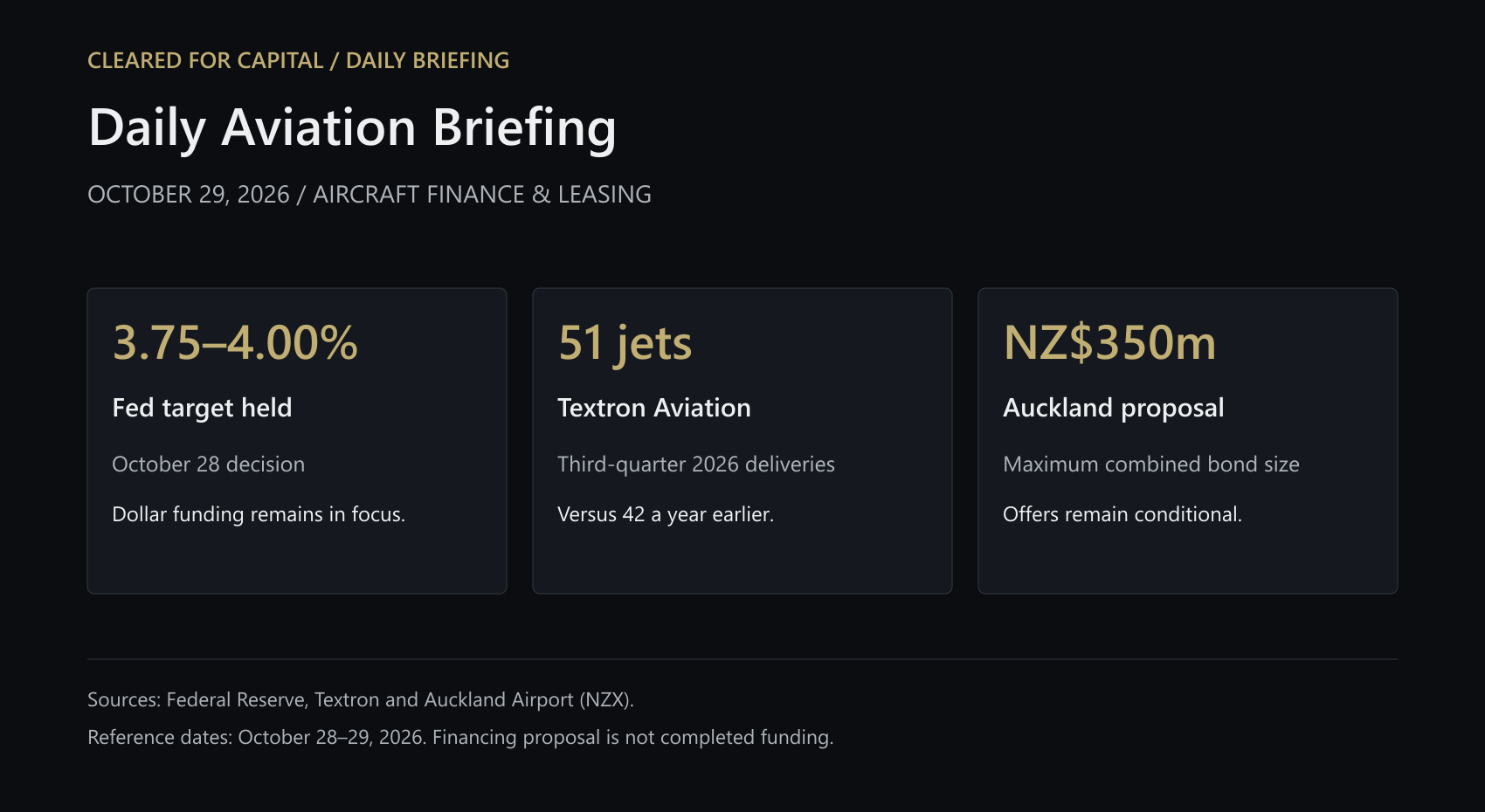
Morning update | Research cutoff: October 29, 2026, 9:13 a.m. New York time (EDT). This first edition covers the preceding 24 hours. It was prepared after the scheduled 6 a.m. release and is being published when ready. Reporting periods and transaction status are identified below.
The Federal Reserve held its policy range, the UK set out a conditional engine-development framework, and fresh fleet disclosures showed where capital is being committed and aircraft are being delivered. For owners and lenders, the useful signals are the terms still to be agreed, the aircraft actually in service, and the cash flows supporting the next round of investment.
Aircraft & Engines
UK–Rolls-Royce framework remains conditional. The UK government’s October 28 announcement describes a joint, ten-year £2.5 billion programme for next-generation civil and defence engine technologies, including the single-aisle opportunity. The financing qualification is important: no new grants have yet been awarded, and future support remains subject to approvals, negotiations and legal processes. Government announcement; Budget documentation.
Our assessment: this is a long-term industrial-policy signal. A lender evaluating an aircraft delivery or an engine replacement should distinguish that framework from an awarded development contract, a certified product or a customer order.
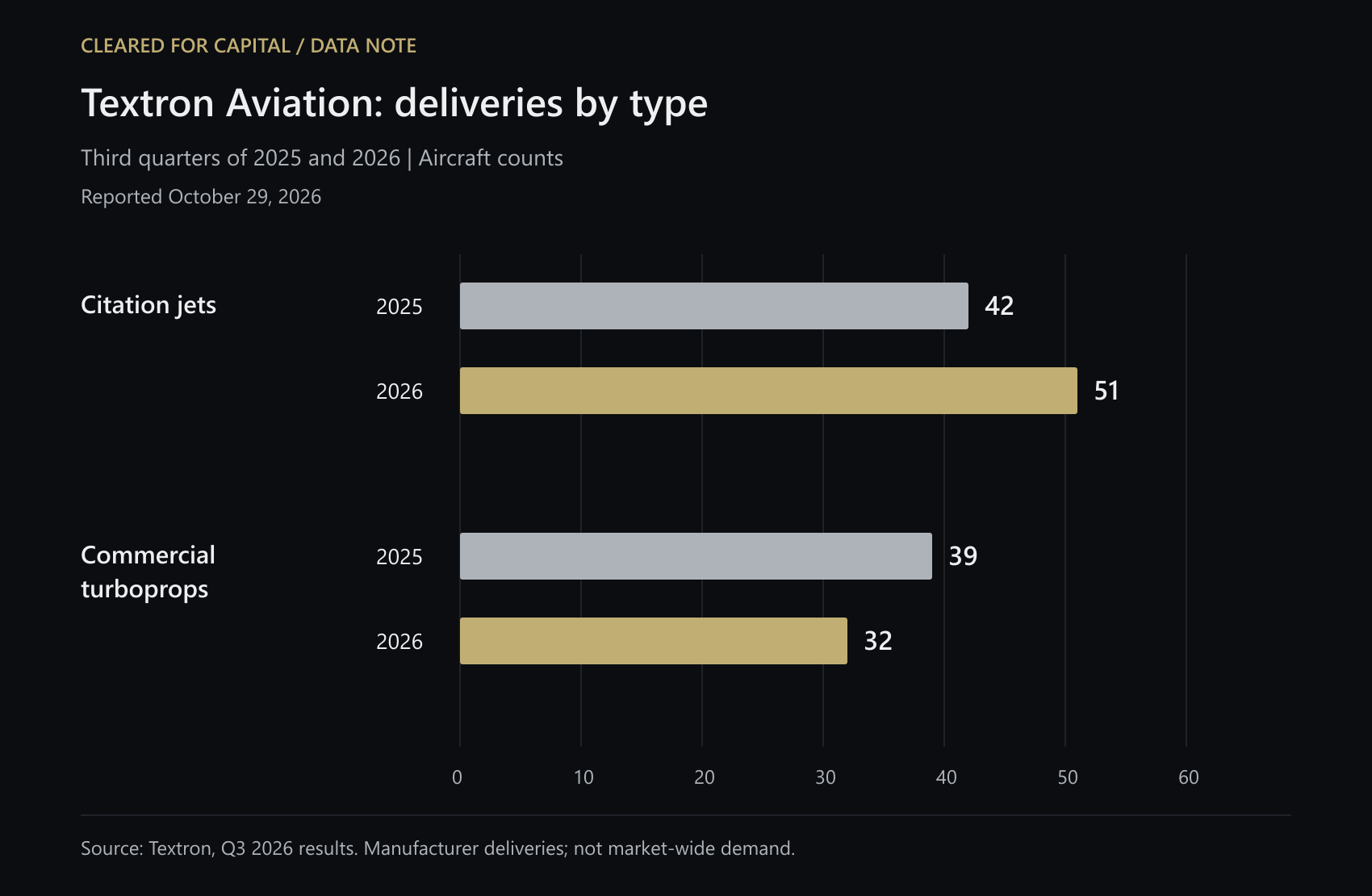
Business-aviation production is uneven. Textron Aviation reported 51 jet deliveries in Q3 2026, compared with 42 a year earlier, while commercial turboprops fell to 32 from 39. Its quarter-end backlog was $8.0 billion. The mix matters when assessing delivery timing and funding requirements for particular aircraft types; these counts do not establish a market-wide demand trend. Textron’s October 29 release.
Source: Textron’s October 29, 2026 results. Aircraft counts for the third quarters of 2025 and 2026. These manufacturer-specific delivery figures are separate from market-wide demand or order counts.
Airspace / Airports
Auckland Airport is considering bond offers. Its October 29 NZX notice outlines possible five-year fixed-rate bonds maturing in November 2031 and wholesale floating-rate bonds maturing in November 2029. If both proceed, their combined maximum size would be NZ$350 million. Details are expected in the week of November 2, subject to market conditions. No retail money is currently being sought, and applications cannot yet be made. Auckland Airport / NZX.
Why it matters: pricing and execution are still ahead. Airport funding conditions offer context for the wider aviation capital market, but airport bonds have different obligors, assets and credit protections from aircraft-backed debt.
Alliances / Mergers
Canada’s competition concerns keep airline coordination under review. In an October 28 report to the transport minister, the Competition Bureau said a proposed Air Canada–United arrangement would likely harm competition on ten Canada–US routes. The airlines account for all non-stop passenger traffic on five of them, according to the Bureau. The existing 2012 restrictions remain in force; the minister’s public-interest review will determine whether the arrangement is authorized. Competition Bureau release.
Our assessment: fleet and revenue assumptions should reflect the current permissions. The Bureau’s finding is a review milestone, with final authorization still to be determined. This is an airline-coordination proposal rather than a merger closing.
Earnings / Fundings
FTAI reports results and a planned buyback. Its October 29 release reports Q3 net income attributable to shareholders of $149.1 million and consolidated adjusted EBITDA of $348.3 million, a non-GAAP measure. It intends to enter a $500 million accelerated share repurchase with Royal Bank of Canada and expects completion in Q4. The prospective agreement and completion timing should be retained when describing this capital-allocation decision. FTAI results and transaction wording.
Fleet / Transactions
FTAI’s acquisition update is cumulative. The same release says SCI I had closed 212 of 301 committed aircraft through September 30. It expects substantially all remaining commitments to close by year-end. SCI II ended the quarter with 109 aircraft committed. These quarter-end programme figures were disclosed today. The year-end completion expectation remains forward-looking, and committed aircraft still require execution. FTAI’s fleet-program disclosure.
Maintenance / Safety
Austrian Airlines adds Embraer component-pool support. In a release datelined October 29, Embraer says its agreement covers Austrian’s current fleet of 13 E195s and more than 300 components, with exchange, repair and overhaul support. The webpage’s publication label is October 28. Embraer announcement.
Our assessment: pooling can support aircraft availability and reduce the operator’s need to hold every spare itself. Owners and lenders should still examine coverage, exclusions and aircraft-return obligations; the announcement does not quantify realized maintenance savings.
Management / Government
The Fed holds at 3.75–4.00%. The October 28 statement, released at 2 p.m. EDT, maintained the federal-funds target range by a 10–2 vote. Both dissenters preferred a quarter-point increase. The statement describes inflation as elevated. Federal Reserve statement.
Implication for financing: dollar-funded aircraft borrowers received no new policy-rate reduction from this meeting. Actual debt service continues to depend on the loan’s contractual benchmark, credit spread and hedging. A policy hold alone does not establish a new aircraft lease rate or refinancing quote.
Network / Traffic
Air Transat adds five planned Canada–Europe routes. Its October 29, 7 a.m. ET announcement adds Montreal–Geneva and Toronto–Birmingham as new destinations for summer 2027, alongside Quebec City–Lyon, Quebec City–Barcelona and Montreal–Faro. The specified seasonal operating periods begin in June 2027. Montreal–St. Maarten and Quebec City–Puerto Plata will also extend into year-round service. Air Transat’s programme and route table.
Why it matters: this gives lessors and airport counterparties a forward view of planned aircraft deployment. Published schedules remain future capacity plans; they do not establish realized traffic, load factors or profitability.
Forward calendar
October 29: the ECB calendar lists its monetary-policy meeting and press conference today. This edition does not report an ECB decision beyond its research cutoff. October 30, 8:30 a.m. New York time: the US Bureau of Labor Statistics schedules the Q3 Employment Cost Index, a further input to inflation and funding expectations.
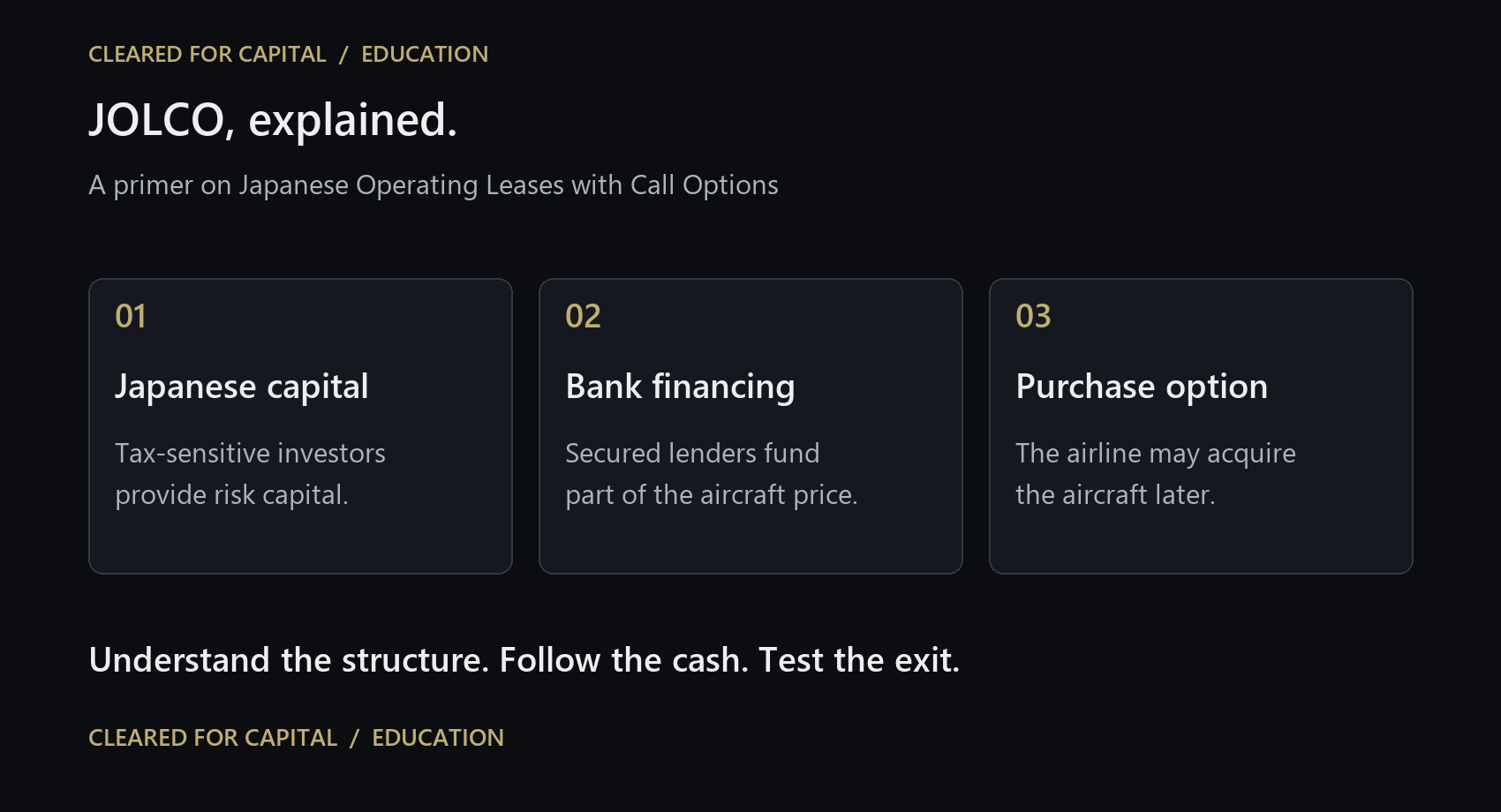
JOLCO stands for Japanese Operating Lease with Call Option. It brings Japanese investment capital and bank lending together to finance an aircraft, leases that aircraft to an airline, and gives the airline a contractual opportunity to buy it later at a price agreed at the outset. JP Lease Products & Services describes the core structure and purchase option.
To understand a JOLCO, follow three things separately: who holds legal title, who supplies the money, and who bears the consequences if the expected aircraft purchase never happens. Those answers reveal more than the word “operating” in its name.
The transaction in five steps
Japanese investors provide risk capital. Common arrangements use a tokumei kumiai (TK, often called a silent partnership) or nin-i kumiai (NK) partnership. “Equity” is useful economic shorthand; it does not mean every investor simply owns shares in the aircraft company.
A Japanese owner or lessor raises secured debt. Bank funding and investor contributions together fund the acquisition. A special-purpose entity holds the aircraft; investors generally do not operate it.
The aircraft is acquired and leased. The airline takes operational use of the aircraft. More complex transactions can include intermediate lessors or subleases.
The airline pays rentals. Those cash flows support debt service, transaction expenses and investor distributions according to the agreed arrangements.
A later purchase option provides a possible exit. If the airline exercises the option, title transfers through the contractual process. If it does not, the remaining lease and return provisions matter.
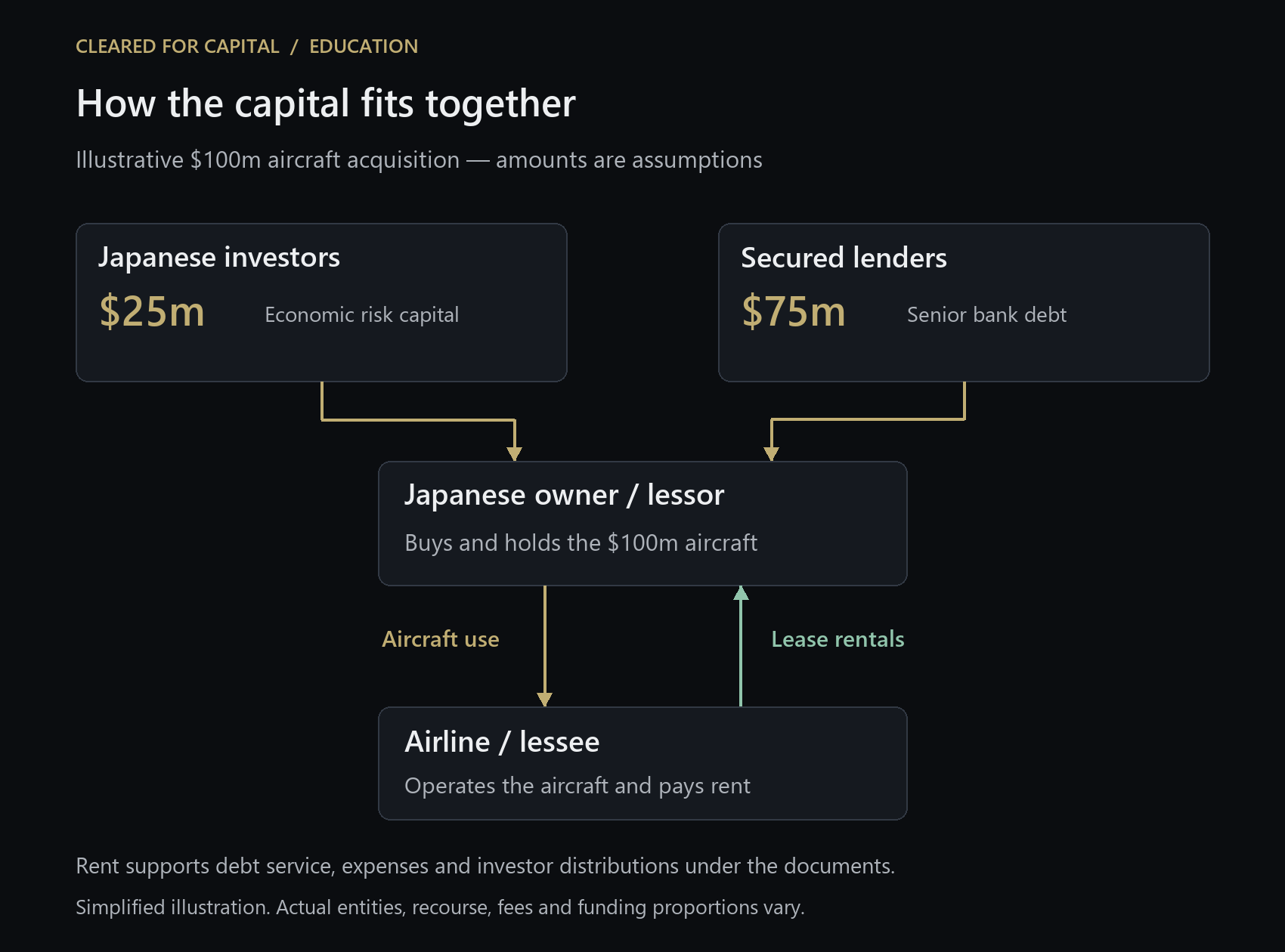
Cleared for Capital illustration. All dollar amounts are hypothetical; this is a funding example, not a financing quote. Actual structures and proportions vary.
What “100% financing” actually means
An airline may obtain funding for the full aircraft acquisition price without supplying that purchase-price equity itself. That does not mean a bank lends 100% of the aircraft’s value: Japanese investment capital fills part of the funding stack. NTT TC Leasing’s published model illustrates approximately 20–30% investor funding and 70–80% bank funding. Those are an arranger’s indicative proportions, not universal rules.
Our diagram uses a hypothetical $100 million aircraft funded with $25 million of Japanese capital and $75 million of debt. The arithmetic describes where the purchase money comes from; it says nothing about the interest rate, monthly rent, investor return or option price. When comparing offers, also ask which fees, deposits and pre-delivery payments are covered.
Why Japanese investors participate
The economic attraction includes the timing of taxable income. Aircraft depreciation and financing expenses can produce early tax losses; eligible investors may be able to use allocated losses against other taxable profits, subject to Japanese tax restrictions. Later profits and exit proceeds can create later tax liabilities. This is generally a tax-deferral mechanism, not a promise of permanently tax-free income. Holland & Knight’s aircraft-finance guide explains how part of that timing benefit can reach an airline through the transaction’s pricing.
Investor tax capacity, the relevant legal structure and recognition limits matter. A useful reading of a proposal therefore separates the aircraft’s commercial performance from the investor’s tax assumptions. A tax benefit does not repair an airline that stops paying rent. The 2026 Japan guide discusses those tax and structural limits.
The call option: expected does not mean guaranteed
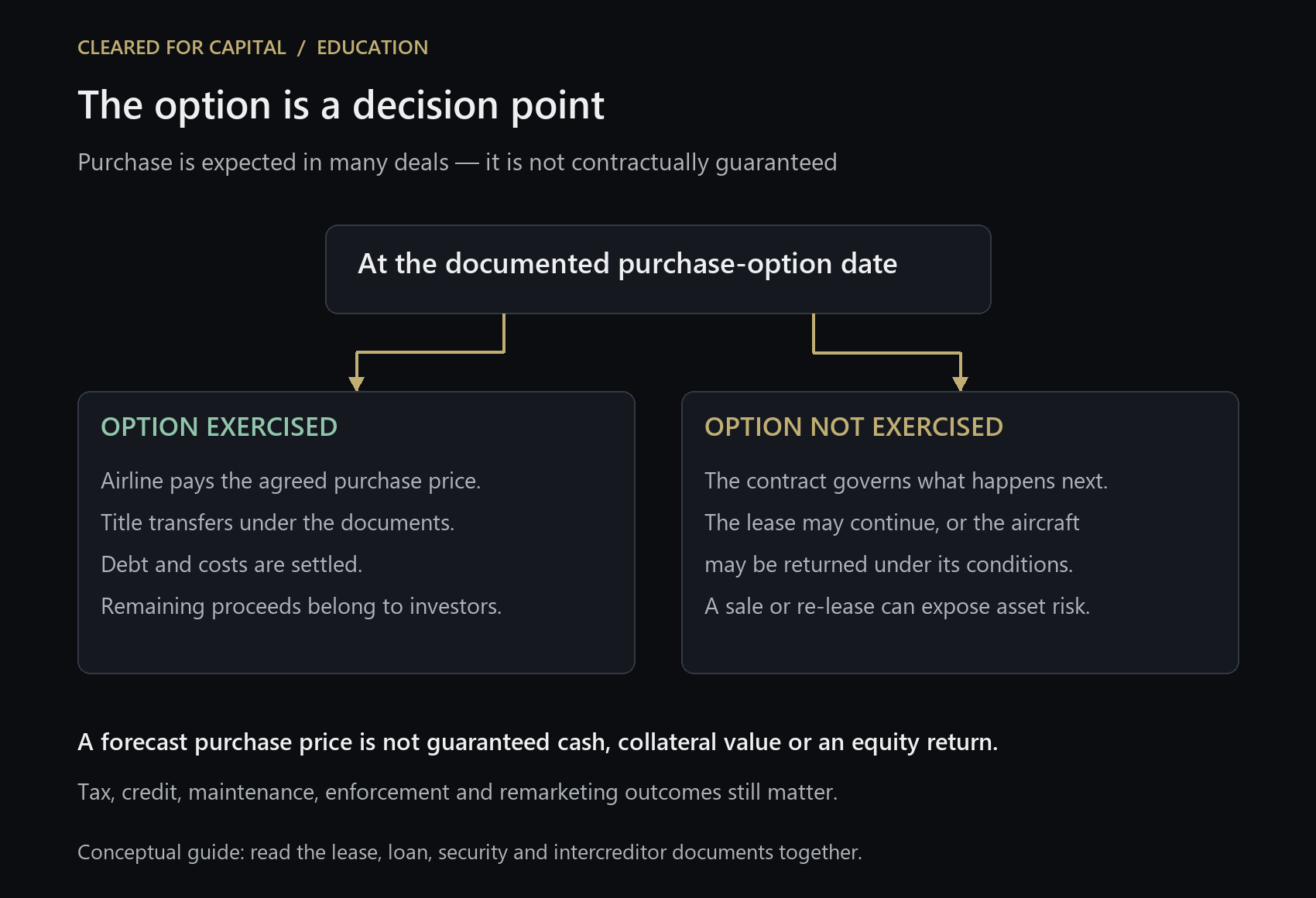
The option normally permits a purchase on a specified date during the lease or at its end, at a price established when the deal is signed. That price is commonly structured around the anticipated future value of the aircraft. It should not be confused with today’s market value, an automatically nominal buyout, or an obligation that applies in every circumstance. JLPS sets out the option mechanics.
Many JOLCO models anticipate that the airline will exercise. The documentation and return economics can make that route attractive, but the distinction between a strong commercial incentive and a binding purchase commitment is fundamental. Pillsbury’s JOL/JOLCO discussion explains why the purchase option shapes the product.
Conceptual overview. Purchase-option dates, return rights and settlement priorities depend on the transaction documents.
JOLCO, JOL and an ordinary operating lease
A JOL also deploys Japanese investment capital, but typically leaves investors with greater exposure to the aircraft’s end-of-lease sale or re-lease value. A JOLCO adds the agreed purchase option and is usually evaluated around an expected airline acquisition. A conventional operating lease from an aircraft lessor commonly centres on rental income and a later return or remarketing, although the actual contract controls. Pillsbury compares the JOL and JOLCO risk profiles.
For the airline, the practical trade-off is funding cost versus flexibility. A JOLCO can support a long-term fleet plan, but changing the structure, extending the term or negotiating waivers may require several parties to agree. Compare the complete cash-flow and consent package with other financing offers. Holland & Knight identifies these flexibility constraints.
“Operating lease” does not mean off balance sheet
Japanese tax classification and an airline’s financial reporting answer different questions. Under IFRS 16, lessees generally recognise a right-of-use asset and a lease liability for leases longer than 12 months, subject to limited exemptions. A JOLCO label alone therefore does not establish off-balance-sheet treatment. Purchase options, the substance of the transaction and the applicable accounting framework still need analysis. The IFRS Foundation explains the lessee accounting model.
Where the risks remain
Airline credit. Rental interruption affects the structure’s cash flow. Look through the brand to the actual lessee, any guarantor and their contractual obligations.
Option and aircraft value. If the anticipated purchase does not occur, maintenance condition, records, return requirements and resale or re-lease value become critical.
Currency and rates. The aircraft, debt, rent and investor contributions need not share a currency. Hedging changes the economics and can generate break costs; ask which party bears each exposure.
Tax assumptions and fees. Investor eligibility, allowable losses, later tax charges and arrangement expenses can change the net result. Gross aircraft cash flows are not the investor’s net return.
Control during distress. Lease defaults, loan defaults, lender transfers and enforcement rights need to be read together. A tidy transaction diagram cannot substitute for the documents.
In July 2026, Norton Rose Fulbright reported advising MUFG on Viva Aerobus’ first JOLCO, supported by equity from Three i’s Capital. The financing related to an Airbus A321-271NX delivered in May 2026. It is a concrete example of airline credit, bank funding and Japanese capital being combined for a commercial aircraft. The disclosure is not a pricing benchmark.
Five questions to ask when reading a JOLCO announcement
Who is the lessee, and who actually guarantees the payment obligations?
What acquisition amount is funded, and which costs sit outside it?
When can the option be exercised, at what price, and what happens otherwise?
How do the rent currency, debt currency, hedging and investor tax assumptions interact?
Who controls amendments, transfers, default remedies and the aircraft’s eventual exit?
A useful first reading treats JOLCO as a funding structure with an expected ownership pathway. Its attraction depends on how credit, asset value, tax timing and contract terms fit together. The purchase option is an essential part of that assessment.
Educational overview, prepared October 28, 2026. Transaction-specific tax, legal and accounting outcomes require specialist analysis. Illustrations are simplified and are not financing or investment quotations.
Deep dive | October 28, 2026 | Commercial aircraft leasing, with engine, cargo and business-aviation context
Aircraft leasing can deliver excellent reported profits after conditions for the next investment have become less attractive. That distinction is central to understanding the industry in late 2026. Scarce aircraft still support owners, but weaker traffic, uneven rental trends and the price of acquiring replacement assets complicate the outlook for new capital.
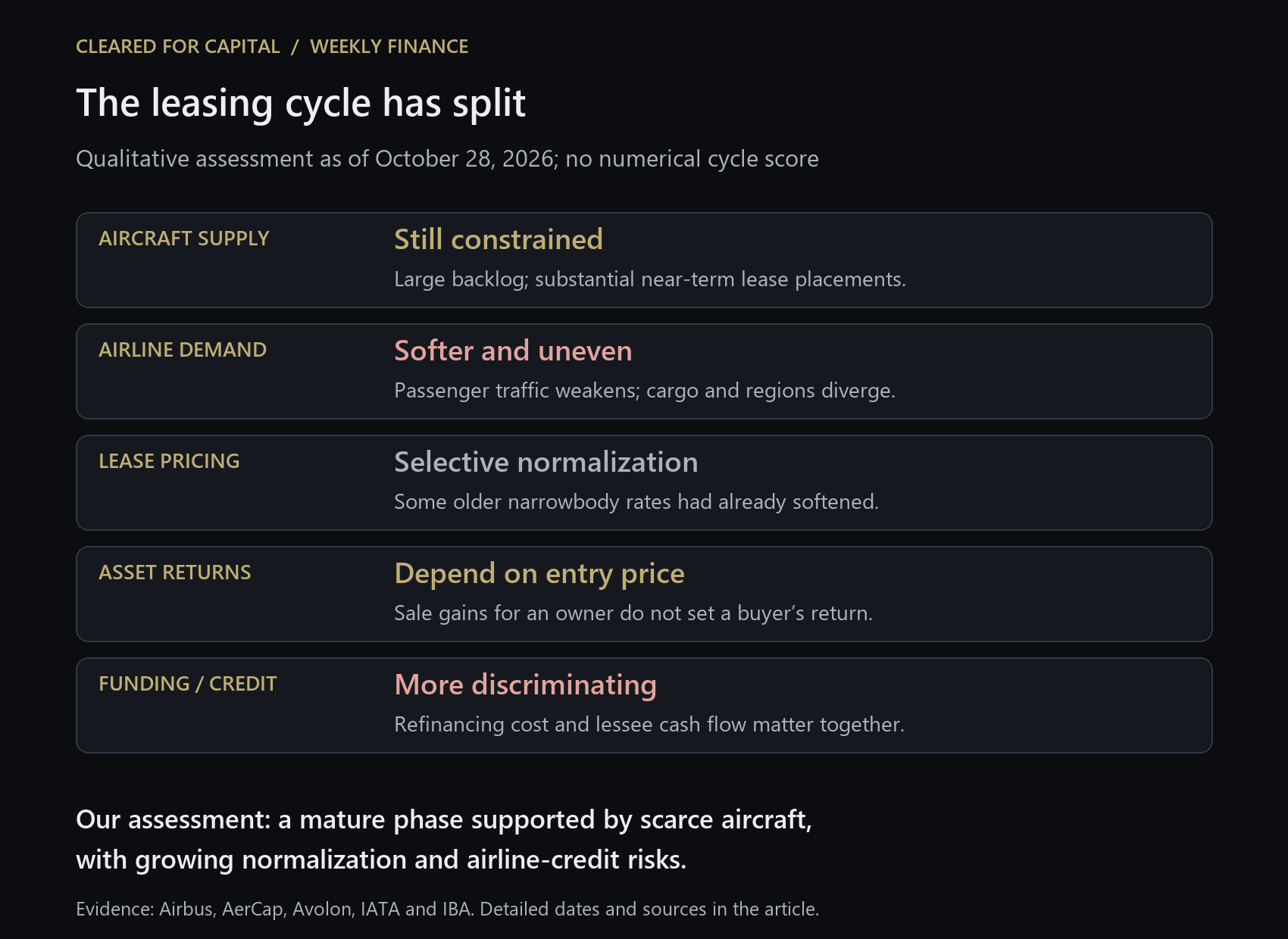
Our assessment: leasing is in a mature phase supported by scarce equipment, with early normalization in parts of the rental market and growing sensitivity to airline credit. The evidence does not establish a single global peak date. It does show a widening difference between earning returns on aircraft already owned and buying aircraft at today’s prices. Investors should read record earnings alongside the economics of the next lease, purchase and refinancing.
Cleared for Capital assessment, based on the dated primary evidence discussed below. This is a qualitative interpretation, not a quantitative cycle index.
Why the leasing cycle has several moving parts
Four developments determine the cycle: airlines’ demand for capacity, the availability of usable aircraft, the price paid for those assets, and the cost and availability of financing. They do not turn together. Aircraft orders can take years to deliver; leases delay the repricing of an existing portfolio; maintenance can keep apparently available aircraft out of service; and debt can refinance before rental income resets.
A typical recovery absorbs parked aircraft and restores collections. A tighter market then improves placement terms and supports asset sales. As production catches up, rents and values can stabilize even while lessors report strong earnings from earlier investments. A downturn becomes more damaging when weaker airline cash flow, aircraft returns and tighter financing reinforce each other. This is a framework for interpreting evidence, rather than a timetable every aircraft type follows.
The business model matters too. This article focuses on operating lessors that retain aircraft and residual-value exposure. An aircraft loan, finance lease, engine lease and ACMI contract—aircraft, crew, maintenance and insurance—have different risks. Short-term operational leasing can respond rapidly to airline capacity changes while a long-term dry lease continues to generate contracted rent.
The evidence: scarce aircraft, softer passenger growth and strong lessor earnings
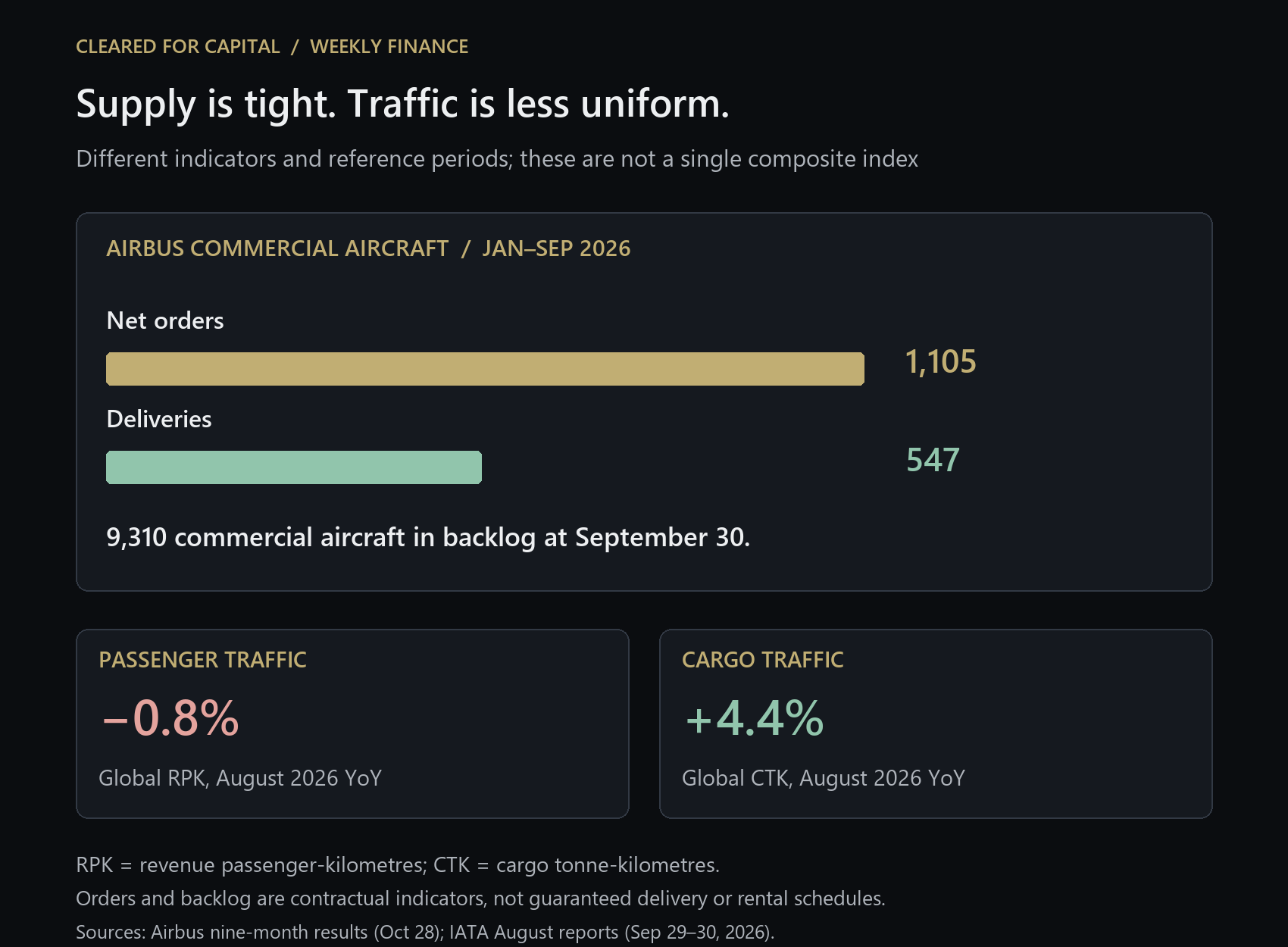
Airbus’s nine-month results, released October 28, report 547 commercial deliveries against 1,105 net orders, with a backlog of 9,310 aircraft at September 30. That supports the case for continued equipment scarcity. It does not establish the delivery date, financing availability or rental rate for an individual aircraft; order books contain delivery schedules, contractual conditions and cancellation risks.
Avolon’s October 9 business update reported that 89% of its committed fleet for the following 24 months was placed at quarter-end. That is meaningful evidence of forward demand for its delivery stream. It is a company-specific placement measure, rather than the percentage of the entire world fleet leased or a measure of airline credit quality.
Sources: Airbus nine-month results released October 28; IATA August passenger and cargo releases published September 30 and 29. Counts of aircraft are separate from traffic growth rates.
Demand sends a less comfortable signal. IATA reported August passenger traffic down 0.8% year-on-year, capacity up 0.3% and an 85.1% passenger load factor. Excluding Middle Eastern carriers, traffic rose 0.6%. The weakness is therefore uneven, with a substantial regional disruption component, rather than evidence that every airline market is contracting. Nevertheless, slower traffic growth reduces the cushion available to absorb expensive fuel, aircraft and financing.
At the same time, AerCap’s October 28 results show $1.009 billion of adjusted third-quarter net income and $353 million of asset-sale gains. Basic lease rents were $1.698 billion versus $1.690 billion a year earlier; maintenance rents and other receipts increased 31%. Adjusted earnings include asset-sale gains. These figures show strong monetization of an existing portfolio, while reminding readers that recurring basic rent, maintenance-related income and gains on disposals are different earnings streams.
That combination is consistent with a mature phase: owners continue to realize value from earlier purchases while the growth and pricing signals become less uniform. Neither one lessor’s profit nor one month’s traffic determines the cycle. Together with placements and rental evidence, they help identify where the pressure is moving.
Lease rates can normalize before aircraft values fall
In a June 2026 chapter using first-quarter valuation evidence, IBA’s Jon Whaley described a second consecutive softening in previous-generation narrowbody lease-rate opinions, alongside slower increases for newer narrowbodies. These are dated appraisal opinions, not October transaction quotes. They are enough to challenge a blanket claim that rental rates are still accelerating for every aircraft type.
A lease rate is the price of using an aircraft over a period. Its asset value also reflects the remaining aircraft life, engine condition, maintenance status and alternative uses. Those components can move differently. A serviceable engine or valuable parts can support an aircraft’s sale price while the rent an airline will pay for the complete aircraft weakens. High maintenance costs can increase the value of usable equipment and simultaneously make an aircraft approaching overhaul less attractive.
For an older narrowbody, an extension can preserve income and avoid transition costs. But the extension’s economics depend on negotiated rent, reserves, maintenance obligations and the next exit opportunity. Counting extensions without reading their terms can hide a softer market. An appraisal also should not be substituted for an executable bid after maintenance, transfer and remarketing costs.
The critical distinction: owning an aircraft versus buying one now
A lessor that acquired an aircraft at a favourable price can earn attractive rent and later sell above depreciated book value. The buyer paying that sale price starts with a different cost basis. A large gain for the seller is not evidence that the buyer will reproduce the seller’s investment return. This is particularly important when scarce assets attract capital that competes more aggressively on purchase price than on lease terms.
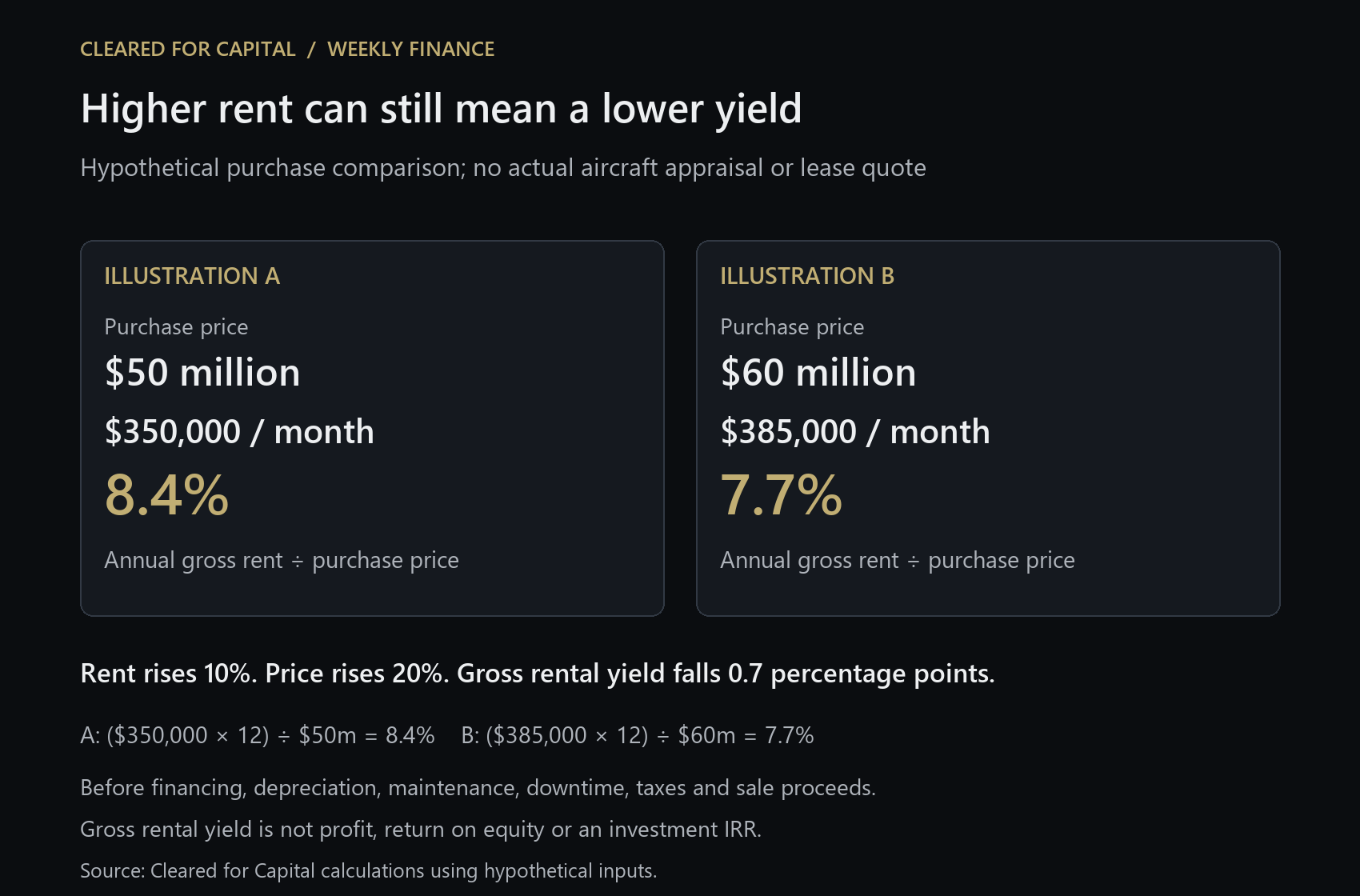
Cleared for Capital calculation using hypothetical inputs. Gross rental yield is annual rent divided by purchase price; it is not profit, return on equity or an investment IRR.
In the hypothetical comparison above, monthly rent rises from $350,000 to $385,000, but purchase price rises from $50 million to $60 million. Annual gross rental yield falls from 8.4% to 7.7%. The calculation is annual rent divided by purchase price; it excludes financing, depreciation, maintenance, downtime, taxes and residual proceeds. It is neither an investment IRR nor an expected market return.
The cycle risk lies in underwriting a high entry price, optimistic renewal rent and a generous exit value together. If those assumptions depend on the same persistent shortage, diversification across many aircraft may provide less protection than expected. A portfolio can contain many assets while remaining exposed to one common supply-and-demand assumption.
Acquisition vintage therefore matters alongside aircraft age. A young aircraft purchased expensively can have less room for error than an older aircraft bought at a low price with its maintenance properly funded. The relevant question is the cash return on the capital committed now, including downside exit assumptions, rather than whether the aircraft belongs to a popular category.
Financing can tighten while existing leases keep looking healthy
AerCap reported an average third-quarter cost of debt of 4.2%, up from 4.0% a year earlier, on its stated measure excluding issuance costs, upfront fees and other impacts. Its average remaining passenger-aircraft lease term was 7.4 years. Those company-specific measures illustrate why funding costs and the repricing of rental income can move on different schedules.
For a lessor with fixed rentals and refinancing ahead, higher debt costs can compress cash margins before the aircraft’s lease expires. For another with matched funding, contracted escalators or effective hedges, the same market change can be more manageable. A headline policy rate does not describe either company’s complete economics. Funding tenor, amortization, currency, hedge collateral and the availability of committed liquidity all matter.
There is also a timing counterweight to an immediate crisis narrative: IATA’s October 16 economics briefing placed most airline refinancing needs beyond the next two years. That aggregate observation does not protect every airline or describe lessors’ own maturity schedules. It does mean the credit analysis should distinguish a borrower with a near-term cash problem from a well-funded operator facing higher costs later.
Leverage magnifies the asset-price cycle. In a separate hypothetical example, a $100 million asset financed with $65 million of debt has a $35 million equity cushion. A 20% asset-value fall leaves $15 million if debt is unchanged: a roughly 57% reduction in that simplified cushion, before costs. This is not a forecast, an issuer’s leverage ratio or a statement about daily accounting marks; it shows how residual risk can reach equity disproportionately.
Airline credit is the link between scarcity and collections
A scarce aircraft is useful protection only if its current lessee pays or another operator can take it on workable terms. Weak traffic, fuel exposure or a currency mismatch can impair collections before an asset’s appraised value declines. Repossessing and moving an aircraft can involve downtime, restoration expense, records work and jurisdictional constraints. Portfolio occupancy alone does not capture those costs.
The pressure can also increase demand for leasing: an airline conserving cash may prefer a lease to a direct purchase. Air Lease’s June-quarter SEC filing describes airline financing needs and tight capital availability as potential supports for leasing, while identifying customer insolvency and higher operating costs as risks. More airline demand for finance does not automatically mean a safer customer or a better risk-adjusted lease.
The earlier warning signs are cash collection, rent deferrals, security top-ups, maintenance shortfalls and weaker terms on replacement leases. Reported earnings can respond later because a long contractual lease and an aircraft appraisal smooth some signals. Our AASET/WAVE deep dive discusses how collections, reserves and aircraft recovery affect the bonds backed by those cash flows.
Engines, widebodies, cargo and business jets occupy different positions
Engine availability and maintenance economics can keep certain assets valuable even when airframe rental growth slows. The analytical distinction is between airworthy capacity that can earn revenue now and a nominal fleet count that includes aircraft awaiting engines, parts or restoration. For a lessor, a higher engine value is helpful only after allowing for technical condition and the cost of realizing that value.
Widebodies also require route, cabin and customer-specific analysis: a shortage on one long-haul network does not make every widebody easy to place elsewhere. In cargo, IATA’s August figures show demand up 4.4% year-on-year while capacity declined 0.1%. That supports a more resilient demand reading than the passenger aggregate, but freight demand is not a guarantee of profitable conversion economics. Feedstock cost, conversion expense, delivery timing and the eventual lessee still determine the return.
Business aviation provides another differentiated picture. Global Jet Capital’s second-quarter 2026 market brief reports 6.6% of the business-jet fleet available for sale, versus a roughly 10% historical average. Availability was 3.7% within the cohort aged 12 years or less, compared with 8.2% for aircraft aged 13 years or more. Its like-aged bluebook basket increased 2.9% year-on-year but only 0.3% quarter-on-quarter. These are inventory and valuation indicators, not closed-sale prices or operating-lease yields.
For business-jet leasing, model liquidity, cabin specification, maintenance-program coverage, borrower strength and the eventual return condition can matter more than an airline-style traffic indicator. Younger aircraft scarcity can coexist with greater choice in older jets. The market evidence supports segmentation and selective normalization, rather than transferring a commercial-airliner cycle label wholesale to every private aircraft.
What would change the cycle assessment?
Our central case is a prolonged mature phase with selective normalization. A severe downturn would require more evidence of weaker collections, harder remarketing and capital withdrawal; a renewed broad upswing would require stronger demand and improving new-investment economics. The following are conditional paths, without assigned probabilities or forecasts of a particular aircraft’s value.
Scarcity persists: delivery and maintenance bottlenecks remain significant, airline liquidity holds up and forward placements stay strong. Incumbent owners retain negotiating power, although high entry prices can still constrain buyers’ returns.
Orderly normalization: usable aircraft supply grows faster than incremental demand. Renewal rents and trading gains moderate, with the outcome varying by model, vintage and maintenance condition. A lessor can remain profitable during this transition.
Credit-led downturn: weaker airline cash flow produces deferrals and returns while debt and transition costs remain high. More available aircraft then weaken remarketing terms, turning a lessee problem into a residual-value problem.
Six indicators worth following through the next reporting cycle
New placements and renewals: compare rents for equivalent aircraft, credits and maintenance conditions, including concessions.
Usable availability: separate airworthy aircraft from parked or maintenance-constrained supply.
Net sale economics: compare actual bids after transition costs with appraisals and book gains.
Funding and maturities: examine each lessor’s refinancing schedule and hedged all-in cost against rental resets.
Capital discipline: test whether new purchases still earn an adequate return under lower renewal rents and more conservative residual assumptions.
The strongest operators can navigate this phase through acquisition discipline, technical capability, diversified customers and reliable funding. A rising sector average cannot substitute for those advantages. In late 2026, the business of aircraft leasing still benefits from scarcity, while the investment decision increasingly depends on the price paid and the ability to withstand a less forgiving next lease.
Sources and method: primary company disclosures from AerCap, Airbus, Avolon and Air Lease; IATA traffic and economics publications; IBA’s authored valuation chapter; and Global Jet Capital’s market brief. Information reviewed October 28, 2026, New York. Reference periods are stated because the releases are not synchronous. Company figures are examples, not a weighted industry census. The cycle assessment and scenarios are Cleared for Capital analysis; hypothetical illustrations are clearly separated from reported data.
Forward outlook | As of October 27, 2026, New York | Calendar through December 18, with 2027 planning context
International aircraft finance faces a concentrated run of rate decisions, economic releases and political events before year-end. The important question is how those developments change the cost of funded and hedged debt, airlines’ ability to pay, the timing of aircraft deliveries and the ability to move assets across borders.
Our base case: financing remains selective, with continued pressure on all-in funding costs unless inflation and energy risks ease. Stronger borrowers with reliable cash flows and marketable aircraft should have more financing options than operators facing weak liquidity, currency mismatches or uncertain delivery dates. This is an analytical judgement, not a prediction of individual central-bank votes or a quoted lending market.
The dated calendar: the first decisions arrive within days
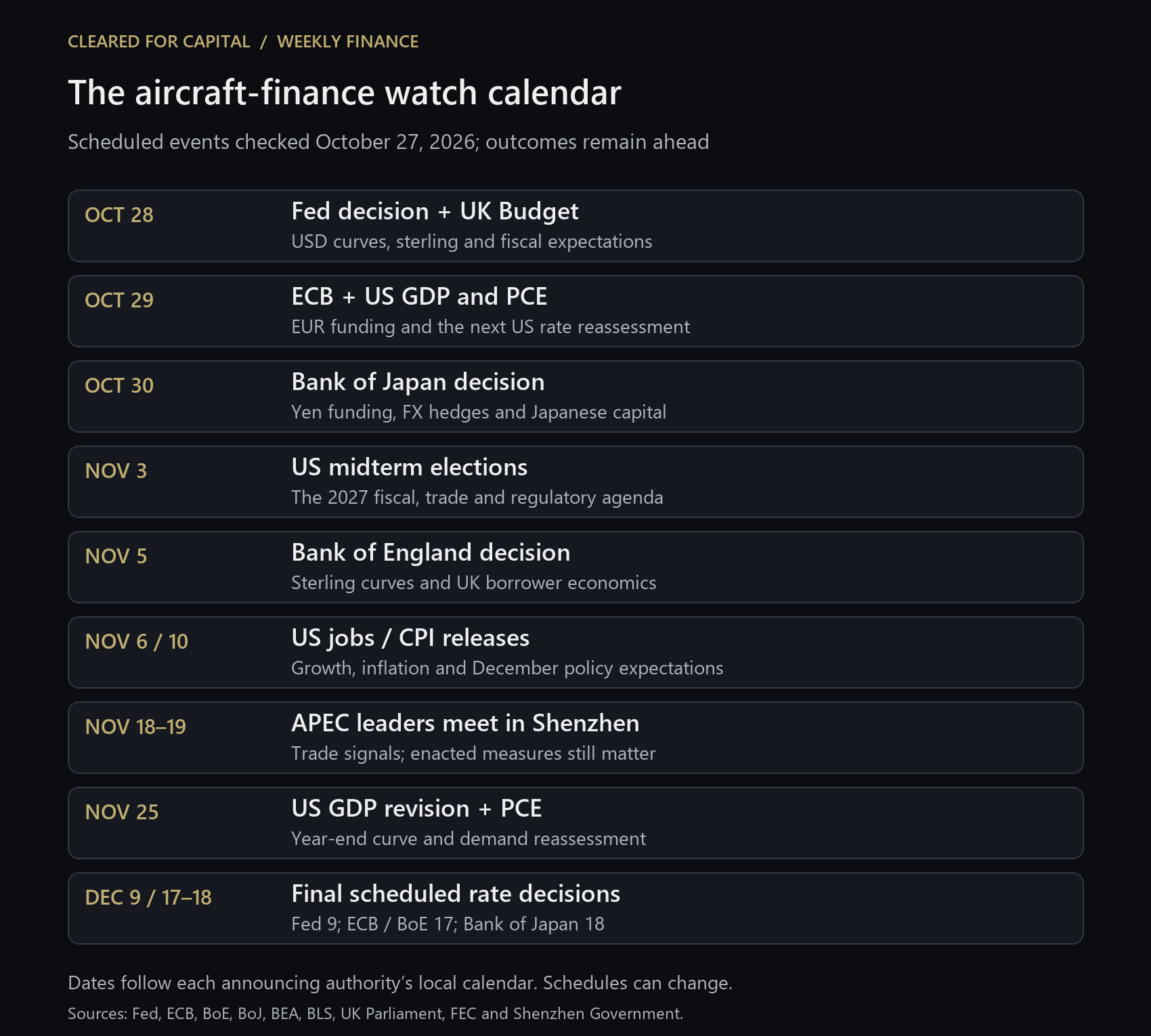
Scheduled events through year-end 2026, checked October 27. Official calendars and primary sources are linked in the accompanying text. Impacts shown are analytical channels, not predicted outcomes.
The final scheduled policy round clusters around year-end funding decisions: the Fed on December 8–9, the ECB and Bank of England decisions on December 17, and the Bank of Japan meeting on December 17–18. These are scheduled events, not assumed outcomes. Dates follow the relevant authority’s local calendar; release schedules can change.
1. Rates: a lower headline rate is not the same as cheaper aircraft debt
Banka Slovenije’s October review, using data available by October 20, described market pricing for a further quarter-point increase by both the Fed and ECB before year-end. That is a dated snapshot, not live meeting odds. Its emphasis on persistent energy-related inflation explains why assuming imminent, broad financing relief would be premature.
Likely effect: policy surprises should feed into benchmark curves, swaps and currencies first. Floating-rate facilities depend on their contractual reset benchmark and any floors; fixed-rate notes and loans depend on the relevant term curve and spread at pricing or hedging. A cut in an overnight policy rate need not produce an equal fall in five-year aircraft debt costs, and existing fixed-rate debt does not automatically reprice.
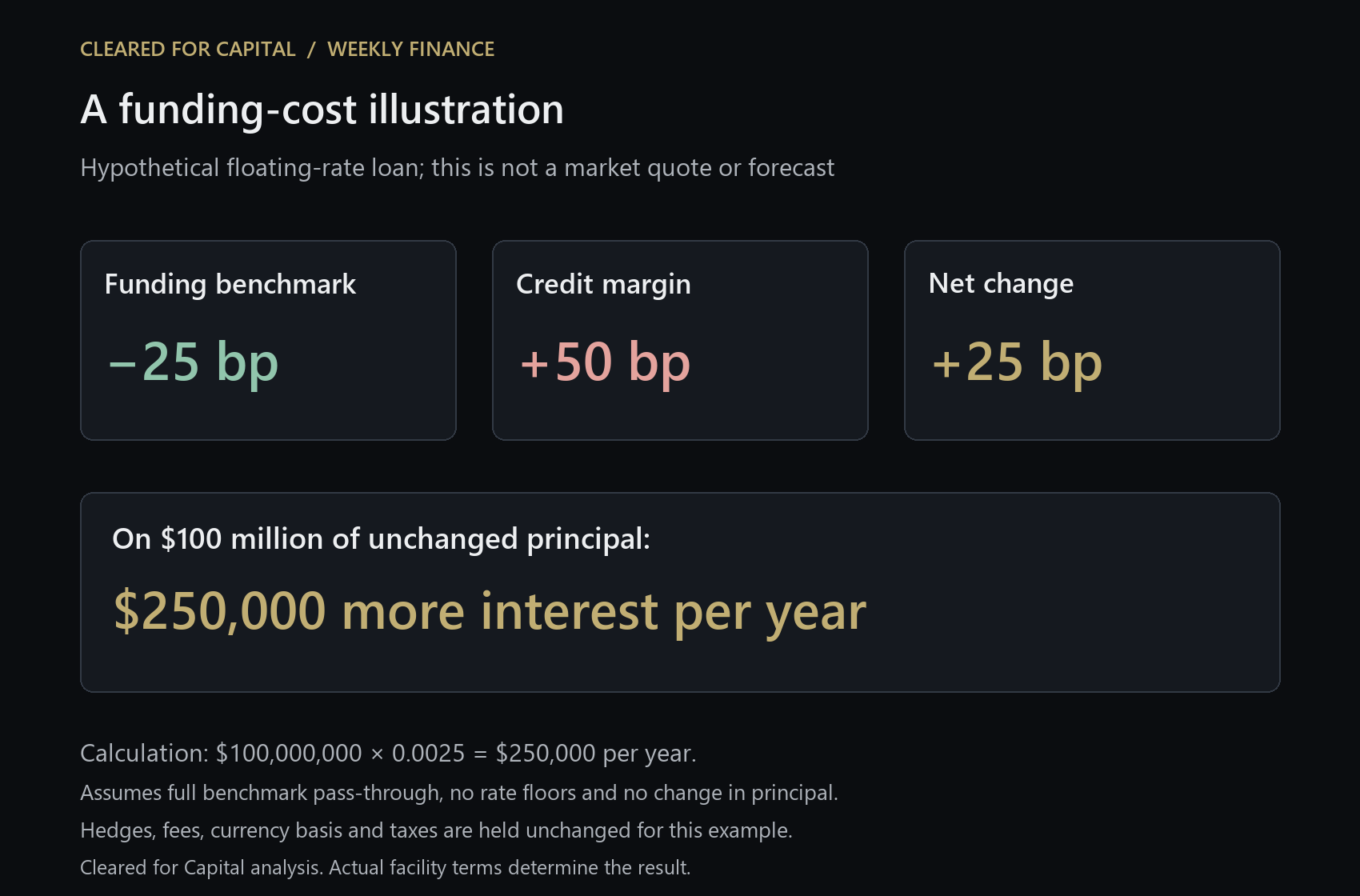
Cleared for Capital illustration: a lower benchmark can be outweighed by a wider credit margin. This is not a current financing quote or forecast.
The example holds hedges, fees, currency basis, taxes and principal constant. In a real deal, those items can alter the outcome. The useful comparison is an all-in financing proposal for the same asset, currency, tenor, amortization and risk allocation—not two central-bank policy rates.
For Japanese and European capital providers, the comparison also includes hedging into the lease currency. The Bank of Japan decision can affect yen funding and investor returns without mechanically moving dollar lease costs in the same direction. Cross-currency basis—the difference between direct currency funding and funding through a currency swap—can change that comparison. The BIS definition explains the distinction; its 2026 foreign-currency funding report also highlights the rollover risk that hedges can introduce.
2. Economic releases: growth and inflation can pull credit in different directions
The October 29 GDP and PCE reports, November 6 jobs report and November 10 CPI report will help shape the next round of rate expectations. They also speak to passenger demand, corporate travel budgets, cargo activity and airline margins. A strong growth print can support traffic while sustaining higher interest rates. Softer inflation can help funding conditions; weaker demand can simultaneously make lenders more cautious.
Our interpretation: the friendliest combination for aircraft finance is easing inflation with resilient cash flows. A slowdown that cuts policy rates but weakens lessee credit may widen margins, reduce advance rates or strengthen reserve requirements. That distinction matters for aircraft ABS, bank loans and private credit alike. Our AASET/WAVE analysis explains how benchmark-rate changes and credit deterioration reach lease-backed bonds through different channels.
Currency exposure adds another layer outside the dollar area. If the local-currency cost of a dollar rises 10%, an unchanged dollar lease payment costs 10% more in local currency before hedges, assuming local revenue is unchanged. The vulnerability is the currency mismatch—not an operator’s nationality alone. Airlines and business-jet operators earning mostly local currency need different stress cases from borrowers with matching dollar income.
3. Financing and deliveries: watch the results, then the cash commitments
Delivery delays can extend pre-delivery-payment borrowing, leave takeout debt undrawn and create additional carry or commitment costs, depending on the contracts. Scarcity may support rentals for aircraft already available, while the owner of an undelivered aircraft still waits for rent to begin. A higher appraised value does not eliminate that timing gap.
For the year-end funding window, the practical issue is whether a commitment, hedge and draw period still match the likely delivery or refinancing date. Banks, leasing companies, ABS investors and private-credit providers do not all have the same capacity or pricing constraints. We expect execution certainty and the terms of committed funding to remain important, particularly around the December decision cluster.
Two disclosed milestones also bear watching: Southwest expects its notes to settle on November 2, while JetBlue expects additional aircraft-backed funding in the fourth quarter. They are issuer-specific tests of execution, not proof that financing is equally available worldwide. Their announced status and source documents appear in our weekly deals briefing.
4. Politics: the UK Budget, US election and APEC have different channels
UK Budget, October 28: the main financing channels are fiscal expectations, gilt yields, sterling and any actual tax measures affecting aviation demand, aircraft ownership or leasing. Watch the published measures and effective dates before changing a transaction model. A fiscal announcement can move funding markets before a tax change affects operating cash flows.
US election, November 3: the outcome can change expectations for the 2027 fiscal, trade and regulatory agenda. Its effect on aircraft finance depends on subsequent measures and the market response, rather than the election date alone. An existing lease, import treatment or financing contract does not change simply because an electoral result is announced.
APEC, November 18–19: the summit offers a near-term venue for Asia-Pacific trade and investment signals. Concrete progress on trade frictions could improve confidence in deliveries and cross-border capital allocation; deterioration could increase uncertainty around parts, aircraft movements and payments. We are not assuming a particular bilateral meeting, aircraft order or tariff agreement will occur.
For transactions involving US imports, the USITC’s current Harmonized Tariff Schedule resources are a starting point for checking the actual product treatment. Aircraft, engines and individual parts can have different classifications and conditions. Broad tariff headlines are not enough to calculate the landed cost of a specific aircraft or lease arrangement.
5. Geopolitics, fuel and carbon: operating costs become credit risks
The Middle East energy and inflation risks discussed in the October central-bank review remain relevant to underwriting. De-escalation could ease fuel, insurance and route-disruption costs; renewed escalation could reverse that relief. The effect on rent-paying ability depends on the airline’s hedges, pricing power, network and liquidity. Lower oil prices alone would not resolve an existing balance-sheet problem.
Sanctions and export restrictions have a different channel: they may affect whether a delivery, payment, maintenance arrangement or repossession can proceed. The European Commission’s current Russia-sanctions materials illustrate why this remains an ongoing cross-border issue. Better credit pricing cannot substitute for an executable transaction and workable asset-recovery route; the relevant rules and counterparties must be assessed at execution.
Year-end also leads into CORSIA’s second phase, beginning in 2027, with participation criteria and exemptions. It operates through multiyear compliance periods, so this is not a universal offset-payment bill due on January 1. In Europe, general free aviation ETS allocation has already been phased out in 2026, alongside separate support for eligible sustainable fuels. These are distinct regimes; route coverage and operator treatment matter. Carbon and fuel assumptions belong in 2027 operating budgets and credit models, without treating every business-aircraft operation as identically covered.
The outlook for international borrowers and investors
Base case: financing stays available on differentiated terms, and benchmark costs, hedge economics and execution risk remain central. Better credits and marketable assets should retain more alternatives; we do not expect every borrower to benefit equally from a change in policy rates.
Upside case: softer inflation, resilient demand and easing trade or energy tensions could lower funding pressure while supporting collections and delivery confidence. Downside case: renewed inflation or geopolitical disruption could keep rates elevated while weakening airline cash flow, making debt both more expensive and harder to execute. These are conditional scenarios without assigned probabilities or bond-price targets.
For business aviation, the same channels reach the borrower through interest expense, currency mismatches, import costs and the timing of delivery and refinancing. For international lessors and aircraft-ABS investors, they also reach portfolio collections, maintenance reserves, remarketing costs and residual proceeds. The decisive question is how a transaction performs under a combined rate, currency and operating-cost shock—not whether a single policy headline sounds favourable.
Sources and method: official central-bank calendars and statements, BEA and BLS schedules, UK Parliament, FEC, Shenzhen Government, ICAO, EASA, USITC, European Commission and the companies cited above. Information checked as of October 27, 2026 in New York; no October 28 or later event outcomes are assumed. Dated facts are distinguished from Cleared for Capital’s analysis. The funding-cost illustration is hypothetical, and this article is informational rather than a recommendation to transact.
Credit analysis | Reviewed October 27, 2026 | Treasury comparison through October 26
Aircraft lease asset-backed securities turn rent and aircraft-sale proceeds into payments for bondholders. Comparing AASET 2026-1 with WAVE 2019-1 shows why a bond’s coupon, collateral, payment history and place in the cash-flow waterfall all matter. A higher Treasury yield can reduce a fixed-rate bond’s value even when its contractual payments are unchanged; weaker lease collections create a separate credit problem.
The distinction is central to this updated analysis. We can verify important issuance terms and dated rating actions. We have not verified executable October 26 secondary-market quotes for either transaction, so the pricing discussion below uses an explicit sensitivity illustration rather than presenting model ranges as current trading levels.
At issuance: funding size needs a careful reading
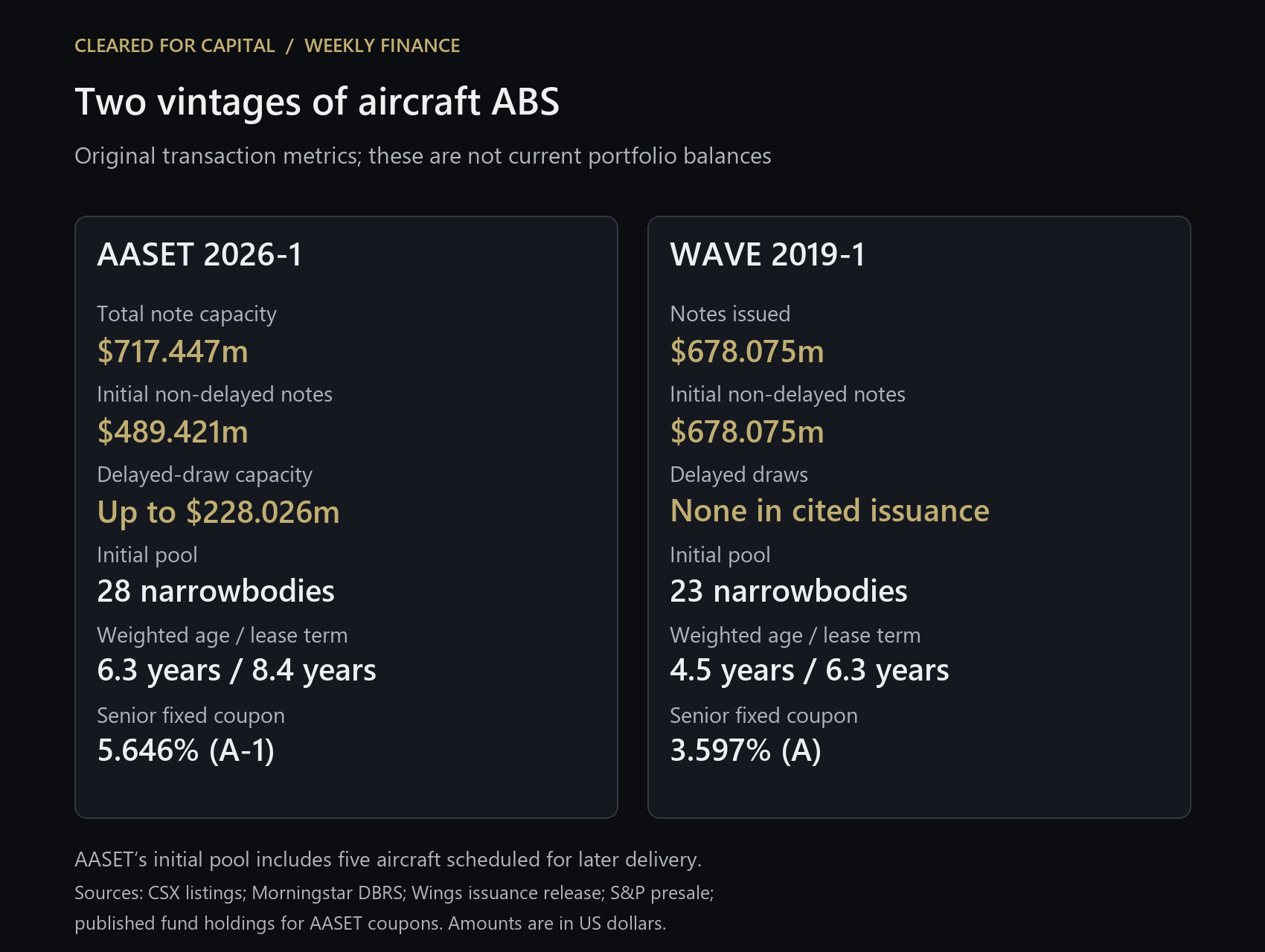
The Cayman Islands Stock Exchange listings identify $436.983 million of AASET A-1 notes, $52.438 million of B-1 notes, up to $203.595 million of delayed-draw A-2 notes and up to $24.431 million of delayed-draw B-2 notes. The arithmetic is $489.421 million of non-delayed notes plus $228.026 million of delayed capacity: $717.447 million in total. That total is not evidence that the whole amount was funded at closing. The separately listed $261.412 million of E certificates is not part of the note total.
Morningstar DBRS’s original analysis says the delayed-draw classes were initially unfunded and would finance up to four A321neos after delivery. Its July 30 final-rating release assigned A (high) (sf) to both A-1 and A-2. These are the ratings at that date; they should not be confused with a fresh surveillance opinion or with the credit rating of the sponsor.
Original issuance metrics. Sources: CSX, Morningstar DBRS, Wings and S&P. AASET coupon cross-checks are linked below.
Transaction / class
Original amount
Fixed coupon
AASET A-1
$436.983m
5.646%
AASET B-1
$52.438m
6.572%
AASET A-2 / B-2
Up to $203.595m / $24.431m
Delayed-draw classes; no coupon assumed here
WAVE A
$555.531m
3.597%
WAVE B
$81.696m
4.581%
WAVE C
$40.848m
6.413%
Wings’ October 1, 2019 issuance announcement gives WAVE’s $678.075 million total and the three final coupons above. AASET coupons are cross-checked against published holdings, including BNY’s July 31 fund schedule and a July 31 Global Opportunities Portfolio filing. Presale coupon assumptions are not final coupons, and a coupon is not a secondary-market yield. All amounts here are original issue amounts or commitments, not current outstanding balances.
Collateral and cash-flow protection
At issuance, DBRS described AASET’s pool as 28 narrowbody aircraft, including five awaiting manufacture and future delivery. Its presale reported a 6.3-year weighted age and 8.4-year remaining lease term. The final analysis cited 75% Series A loan-to-value, a liquidity facility sized to nine months of Series A interest, and an initially funded $50 million maintenance reserve. It also described performance triggers and an expected final payment date seven years after closing. The legal final maturity and the expected repayment date serve different purposes.
For WAVE, the September 2019 S&P presale described 23 aircraft, 17 airline lessees, a 4.5-year weighted age and a 6.3-year remaining lease term. It identified substantial emerging-market lessee exposure. These are starting characteristics, not a description of the fleet or its remaining leases today.
Our interpretation: Longer contracted leases can improve visibility, but rent still depends on airline payment capacity. A maintenance reserve can absorb designated expenses without guaranteeing full recovery. A liquidity line addresses timing shortfalls within its terms; it cannot indefinitely replace missing rent. The relevant test is whether collections and net sale proceeds meet the transaction’s actual obligations after expenses, reserve requirements and payment priorities.
WAVE’s rating history: the CreditWatch review was resolved
The historical record should not stop at February 2023. In its May 2023 review, S&P affirmed WAVE A at BBB+ (sf) and B at BB+ (sf), lowered C to CCC+ (sf), and removed the ratings from CreditWatch negative. It cited scheduled-principal shortfalls and insufficient protection for the junior class. Those are dated historical ratings, not a claim about each class’s current rating.
KBRA’s January 9, 2026 surveillance announcement includes WAVE among transactions serviced by Castlelake or its affiliate. Its public summary discusses affirmations and upgrades across the group, without identifying every class action in the summary itself. A current investment decision needs the class-specific agency record and current trustee data; the earlier watch status should not be carried forward as though it remains unresolved.
The S&P review also identifies WAVE’s 144A class A CUSIP as 94354KAA8, B as 94354KAB6 and C as 94354KAC4. A valid identifier check digit is useful, but only a security record or transaction document establishes the class mapping.
Rates versus credit: what the price model can show
The US Treasury’s daily par-yield data show the five-year yield at 4.26% on July 15 and 4.84% on October 26: a rise of 58 basis points. The ten-year moved from 4.55% to 5.00%, or 45 basis points. These observations retain the original article’s October 26 comparison date and correct its benchmark endpoints.
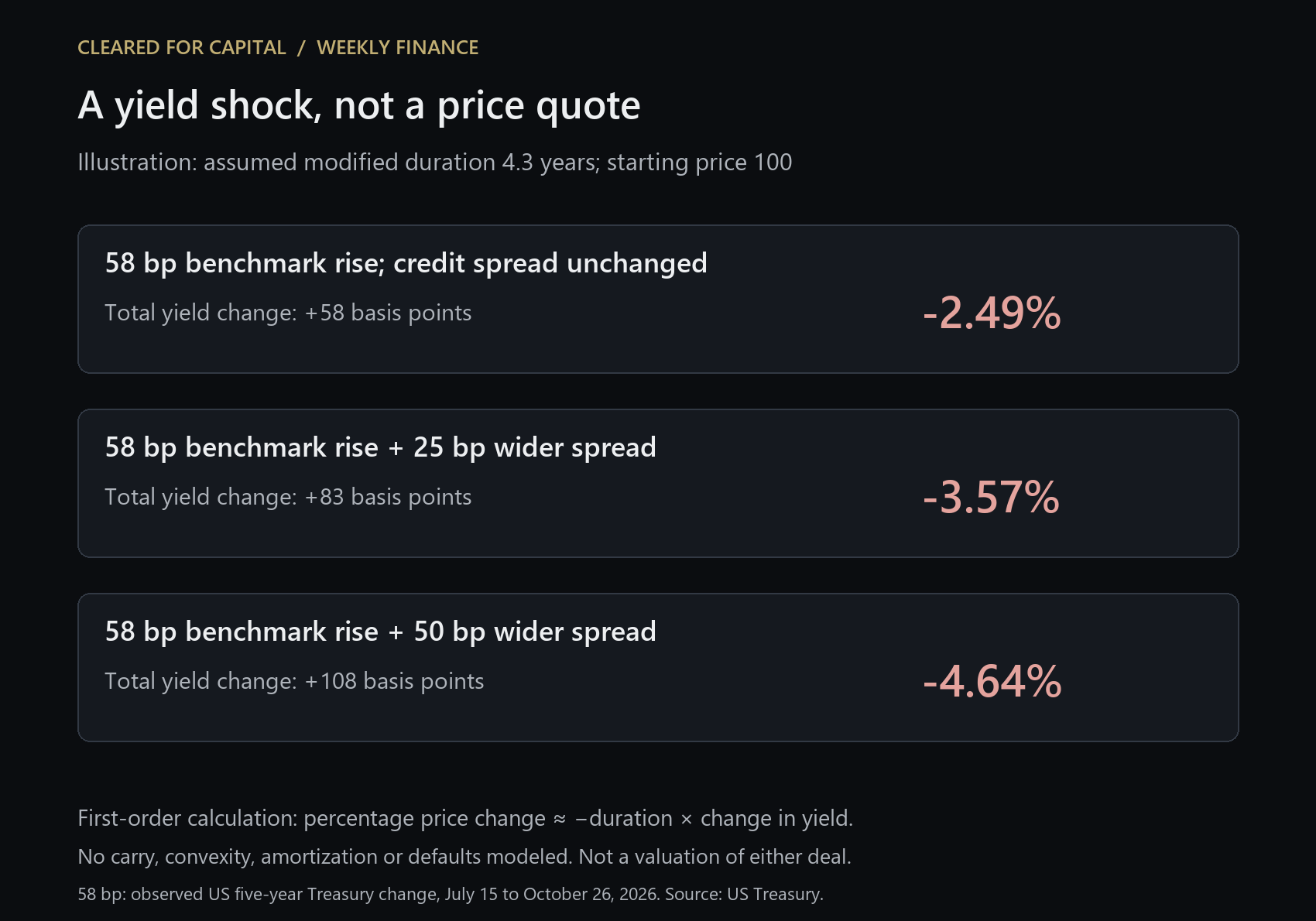
For an illustrative bond with an assumed modified duration of 4.3 years, the first-order calculation is percentage price change ≈ −modified duration × yield change. A 58-basis-point rise in the bond’s required yield would imply about a 2.49% decline, or 2.49 points from a starting price of 100. That duration is a scenario assumption, not a measured duration for either AASET or WAVE. A five-year Treasury move is also only a benchmark proxy, not the full term structure used to value amortizing ABS.
Illustrative model, not observed ABS prices. The US Treasury benchmark moved 58 basis points between July 15 and October 26; duration and spread shocks are explicit assumptions.
The illustration excludes coupon carry, principal distributions, convexity, defaults and changes in cash-flow timing. Spread widening would add another source of price pressure; falling rates could offset some credit-related widening. A true then-versus-now comparison requires dated clean prices, accrued interest, current principal factors and intervening cash distributions. Comparing an original face amount with today’s amortized position will not produce a valid total return.
What we can and cannot call a market price
Rule 144A status alone does not prove that trade information is unavailable. FINRA’s SPDS-144A documentation describes dissemination of transactions in certain eligible asset-backed securities. Coverage, access and trade frequency still need checking for the specific instrument. We did not verify a dated secondary trade or executable quote for these classes during this review. That is a limit of this evidence, not a statement that no reported trades exist.
For the same reason, this version does not present the earlier AASET and WAVE model price bands as observed October 26 prices, assign probabilities to oil-and-credit scenarios, or describe an unverified discount as a buying opportunity. To value WAVE’s low-coupon amortizing notes, the remaining principal schedule and actual waterfall matter at least as much as a generic assumed weighted-average life.
Airline stress is the transmission mechanism
Fuel, fares and traffic matter because they affect lessees’ ability to pay rent. Stress can then reach ABS through delayed collections, lease restructuring, repossession costs, downtime, re-leasing economics and aircraft sale values. A junior class generally has less protection from deterioration in available cash than a senior class, subject to the particular transaction’s terms.
Recent operating disclosures show why airline and lessor conditions need separate examination. JetBlue’s October 26 results reported $2.2 billion of liquidity, including a $600 million undrawn facility, with another $250 million of aircraft-backed funding expected in the fourth quarter. AerCap’s third-quarter activity update reported 85 lease agreements and 34 asset purchases; those totals include engines or helicopters as well as aircraft. Active transactions do not by themselves establish lease profitability or immunity from airline defaults.
These companies illustrate sector conditions. This article does not identify them as lessees of either ABS pool without supporting portfolio disclosure. Airline share prices are also not prices for lease-backed notes. For dated equity context, see our weekly aircraft-finance roundup.
The Cleared for Capital view
The comparison remains useful when each vintage is judged on its current cash flows. For AASET, follow aircraft deliveries and delayed funding, collections, maintenance spending and trigger headroom. For WAVE, focus on the latest principal factor, unpaid scheduled amounts, lease expirations, aircraft dispositions and class-specific surveillance. Rates can move prices before credit changes, while weak collections can change both expected timing and ultimate recovery.
For business-aircraft owners and financiers, the transferable lesson is to separate funding cost, borrower credit and asset recovery. These commercial-aircraft securitizations do not establish the loan margin, advance rate or residual value available on a private jet. Any comparison needs the relevant asset, jurisdiction, maintenance condition and financing contract.
Source note: adapted and updated from the author’s October 26 feature at The Closing Print. Reviewed October 27, 2026. Issuance facts, historical rating actions and model assumptions are labelled separately. Current trustee balances, class-specific current ratings and executable secondary quotes were not independently confirmed. Analysis is informational and is not a recommendation to transact.
Completed aircraft transactions, expected borrowing and bond pricing featured in the October 21–27 announcements. This briefing separates reported completions from funding still ahead, then examines share-price moves for listed airlines around the news.
DAE reported completion of its ten-aircraft United Airlines mandate, ABL acquired a leased A320neo, and JetBlue flagged expected fourth-quarter financing. Related capital raises cover the aviation aftermarket and Southwest’s corporate refinancing.
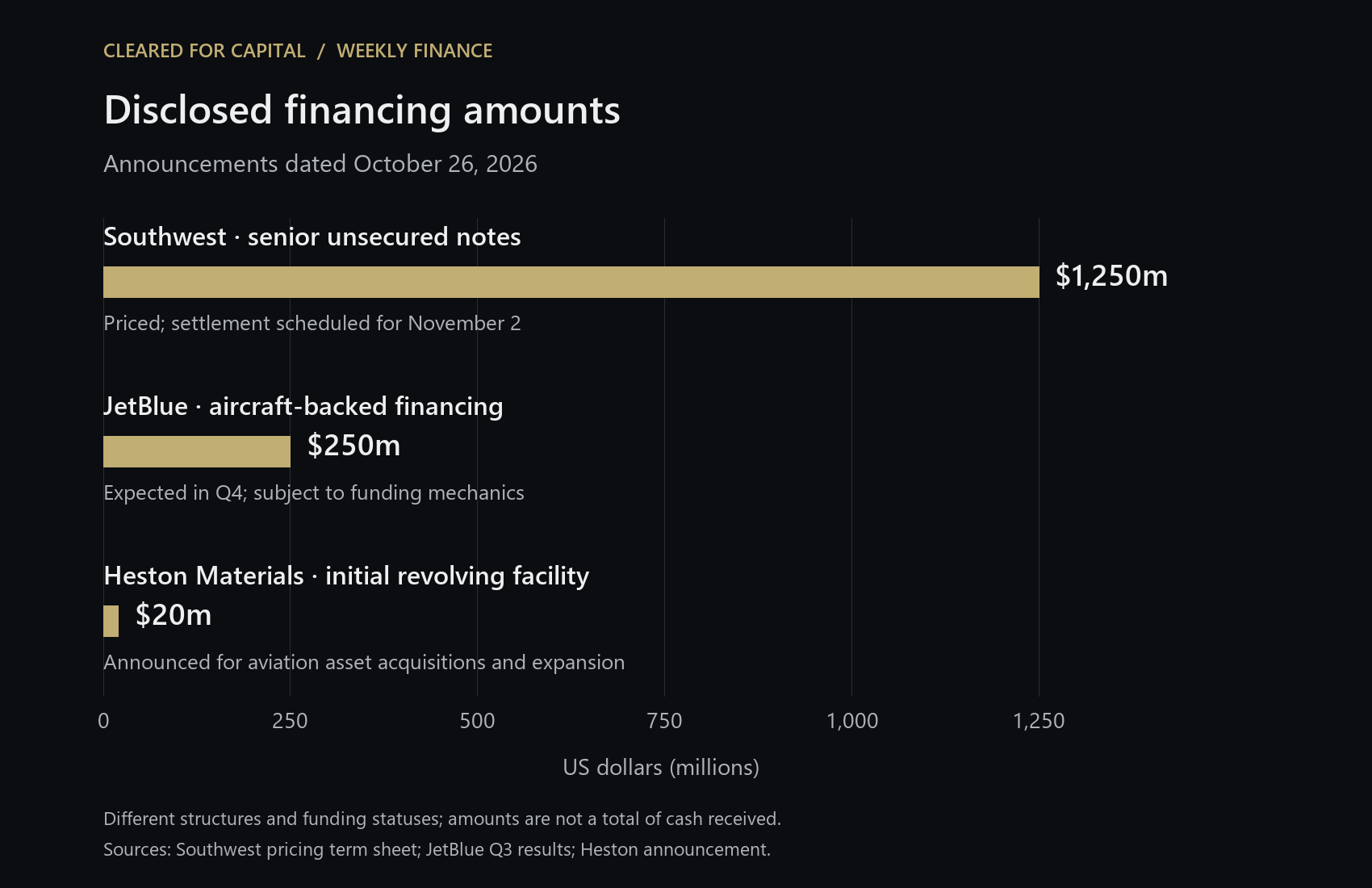
Aircraft-backed financing expected to fund in Q4, subject to funding mechanics
Closed this week: completed deals reported October 21–27
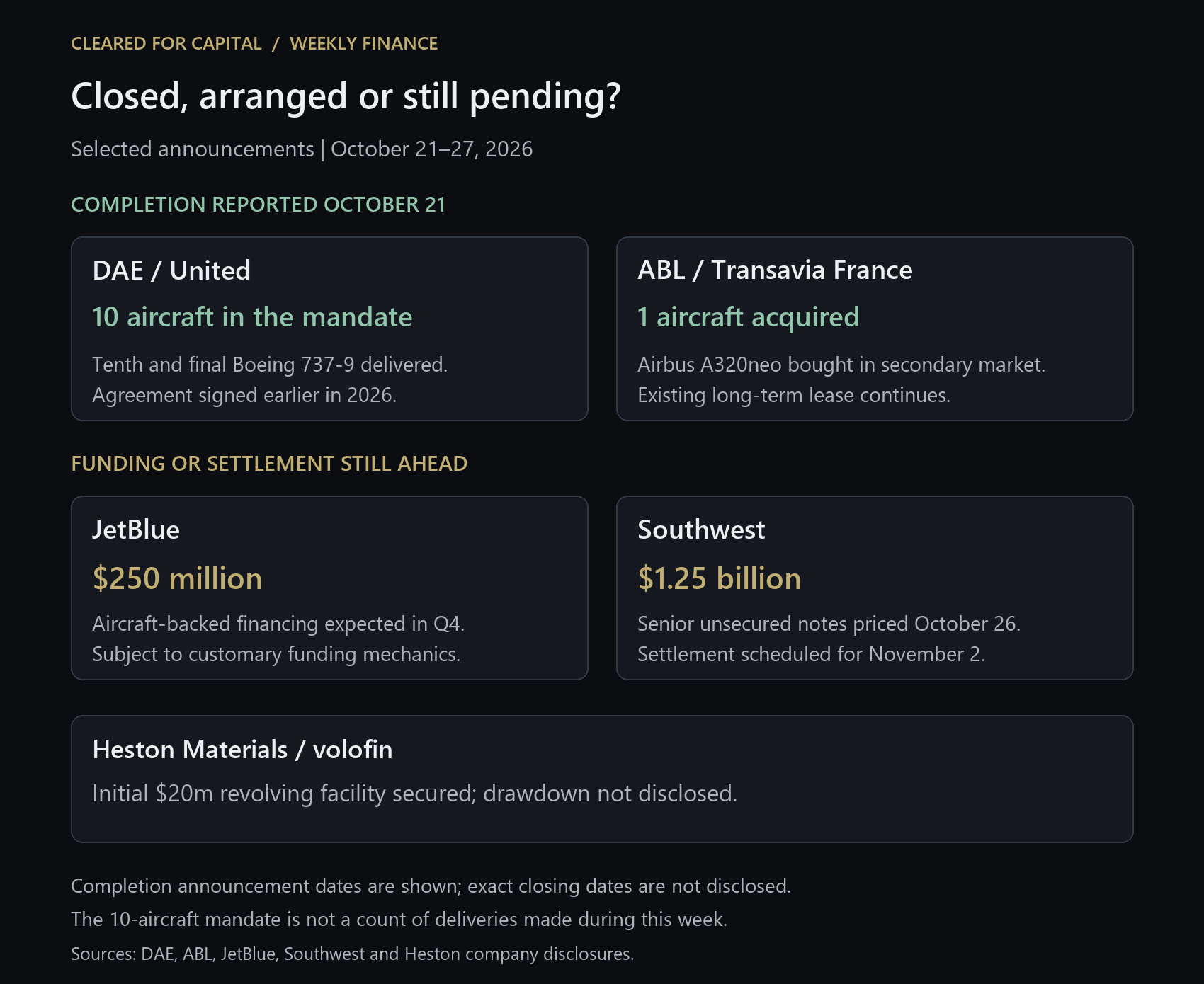
Both transactions below were reported as completed in company announcements dated October 21. The releases do not give separate legal closing dates. “Closed this week” therefore identifies completion reports published during the week; it does not establish that every aircraft transfer occurred within these seven days.
DAE completes its ten-aircraft United sale-and-leaseback
DAE announced on October 21 that it had delivered the tenth and final Boeing 737-9 to United under a sale-and-leaseback agreement signed earlier in 2026.
The mandate was completed in three months from document execution. DAE said the transaction was executed with Equator and Mustang, with DAE Capital acting as servicer. Its overall fleet on lease to United reached 26 aircraft.
This is a newly announced completion milestone, rather than a ten-aircraft agreement first signed during the reporting week. DAE did not disclose the transaction value or lease pricing.
ABL buys an A320neo with the Transavia France lease attached
ABL Aviation’s October 21 announcement confirmed the acquisition of an Airbus A320neo powered by CFM LEAP-1A24 engines through a secondary-market transaction.
The existing long-term lease to Transavia France remains in place. The announcement describes an aircraft investment transaction; it does not disclose the purchase price, seller or acquisition debt terms. It should not be read as a newly originated lease or a newly delivered aircraft.
JetBlue flags $250 million in aircraft-backed financing
In its October 26 earnings announcement, JetBlue said an additional $250 million of aircraft-backed financing was expected to fund in the fourth quarter, subject to customary funding mechanics.
The airline reported $2.2 billion of quarter-end liquidity, including an undrawn $600 million credit facility. It also put its unencumbered asset base at approximately $7 billion, including $2.8 billion in aircraft and engines.
The $250 million should therefore be tracked as expected funding, rather than cash already received. The disclosure does not specify the lender, interest rate, maturity or aircraft securing that amount.
Related capital: aftermarket assets and airline refinancing
Heston Materials secures an initial $20 million facility
On October 26, Heston Materials announced initial financing of $20 million from volofin Capital Management for aviation asset acquisitions and business expansion. A company-issued statement carried by ELTA describes flexible funding to support acquisition opportunities.
The English-language announcement carried by AVIATOR identifies a revolving facility. It gives no maturity, interest rate or collateral terms. This is aviation aftermarket financing, with no specific aircraft purchase identified. The disclosure does not establish whether any of the facility had been drawn by the reporting cutoff.
Southwest prices $1.25 billion of senior unsecured notes
Southwest’s October 26 pricing term sheet sets out $600 million of 5.750% notes due in 2029 and $650 million of 6.000% notes due in 2031. Settlement is scheduled for November 2.
Its prospectus identifies the notes as general unsecured obligations. Proceeds are intended for general corporate purposes, potentially including repayment of $300 million of notes maturing in November. This is broader airline financing, rather than a disclosed loan against particular aircraft.
Stock-market context: what moved around the announcements
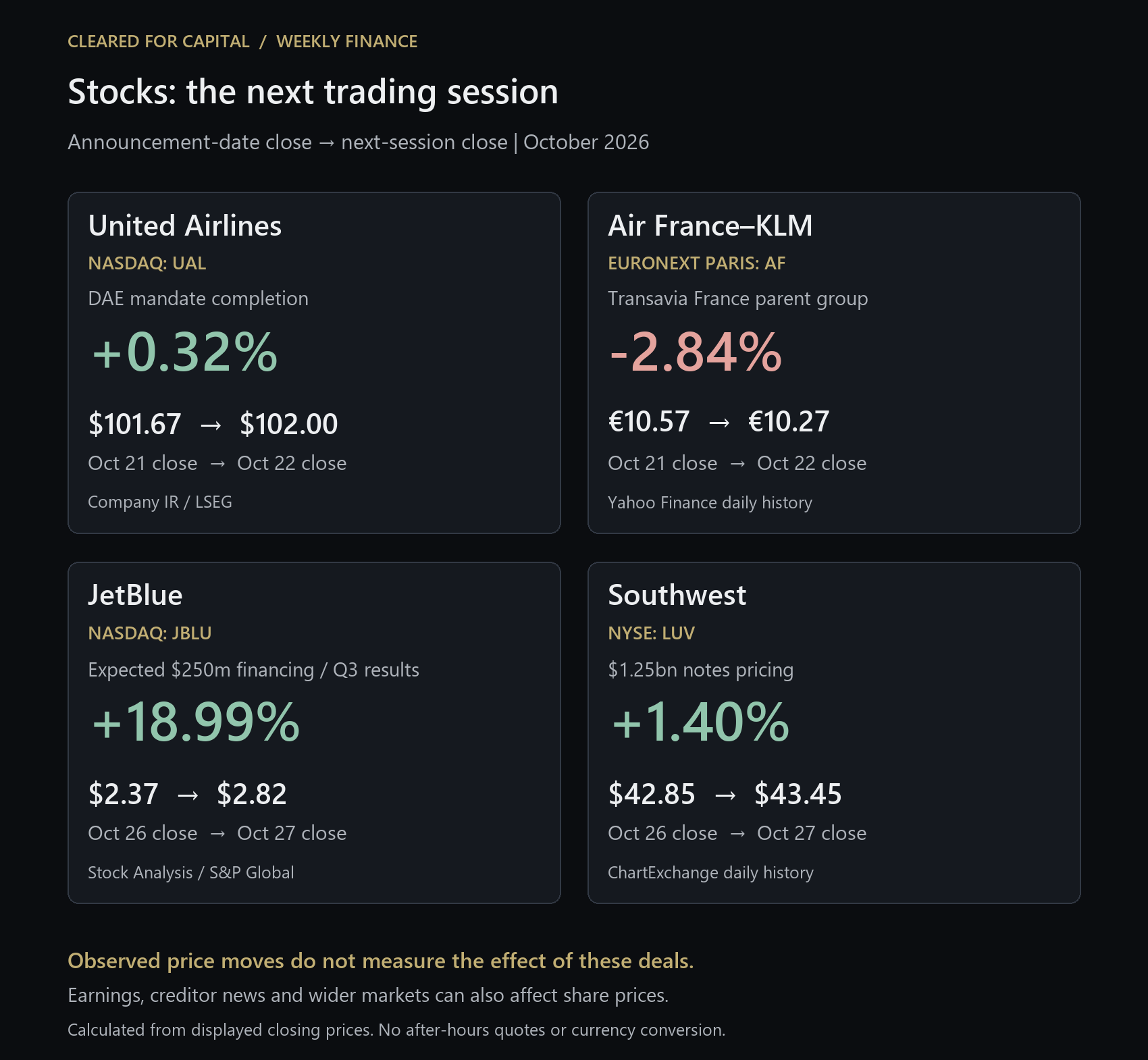
The listed airline exposures covered here are United Airlines Holdings (NASDAQ: UAL), JetBlue (NASDAQ: JBLU), Southwest (NYSE: LUV), and Air France–KLM (Euronext Paris: AF), the parent group of Transavia France. The infographic compares each announcement date’s regular-session close with the next trading session’s close.
United / DAE: United closed at $97.77 on October 20 and $101.67 on October 21, a calculated 3.99% increase on the completion-announcement date. It closed at $102.00 on October 22, another 0.32%. These company-published closing prices show an observed rise, but do not isolate the contribution of the sale-and-leaseback. The completion release gives no transaction value or quantified earnings effect.
Air France–KLM / ABL: The Paris-listed parent group closed at €10.47 on October 20, €10.57 on October 21 (+0.96%), and €10.27 on October 22 (−2.84%), using daily historical closes. This tracks the airline’s parent, not ABL’s investment performance. The acquired aircraft’s existing lease continued; the announcement and these prices do not establish a deal-specific share-price effect.
Southwest: LUV closed at $42.85 on October 26 and $43.45 on October 27, a calculated 1.40% increase, using ChartExchange’s daily closes. The company’s pricing release was published at 5:08 p.m. EDT on October 26, after the regular market close. The earlier October 26 gain of 2.63%, from the October 23 close of $41.75, preceded that release and should not be described as its reaction. The following session’s gain alone does not establish a bond-pricing effect.
Method and attribution: Percentage changes are calculated from the displayed closing prices, rounded to two decimals, in each listing’s local currency. The infographic uses announcement-date close to next-session close consistently; same-day comparisons are identified in the text. These are price changes, excluding dividends and after-hours trading. Earnings, company news and wider market moves also matter. No deal-specific causal effect has been established from the sources reviewed.
What this means for business aviation
Our reading is that these announcements illustrate several uses of aviation capital: raising liquidity against assets, completing fleet ownership transactions and funding assets already earning lease income. That is useful context for business-aircraft owners and investors, even though the assets and counterparties differ.
They do not establish private-jet loan rates, advance rates or residual-value assumptions. The commercial-aircraft transactions reported here provide no basis for inferring the terms a business-jet borrower could obtain.
The next milestones are whether JetBlue receives the expected funding in Q4 and whether Southwest settles its notes on November 2. For the completed DAE and ABL transactions, pricing and financing details remain undisclosed.
Scope: selected public announcements dated October 21–27, 2026, reviewed as of October 27 in New York. This is a report on disclosed transactions, not an exhaustive record of private financings. Analysis is identified separately from announced terms.