
Education | Aircraft finance fundamentals
JOLCO stands for Japanese Operating Lease with Call Option. It brings Japanese investment capital and bank lending together to finance an aircraft, leases that aircraft to an airline, and gives the airline a contractual opportunity to buy it later at a price agreed at the outset. JP Lease Products & Services describes the core structure and purchase option.
To understand a JOLCO, follow three things separately: who holds legal title, who supplies the money, and who bears the consequences if the expected aircraft purchase never happens. Those answers reveal more than the word “operating” in its name.
The transaction in five steps
- Japanese investors provide risk capital. Common arrangements use a tokumei kumiai (TK, often called a silent partnership) or nin-i kumiai (NK) partnership. “Equity” is useful economic shorthand; it does not mean every investor simply owns shares in the aircraft company.
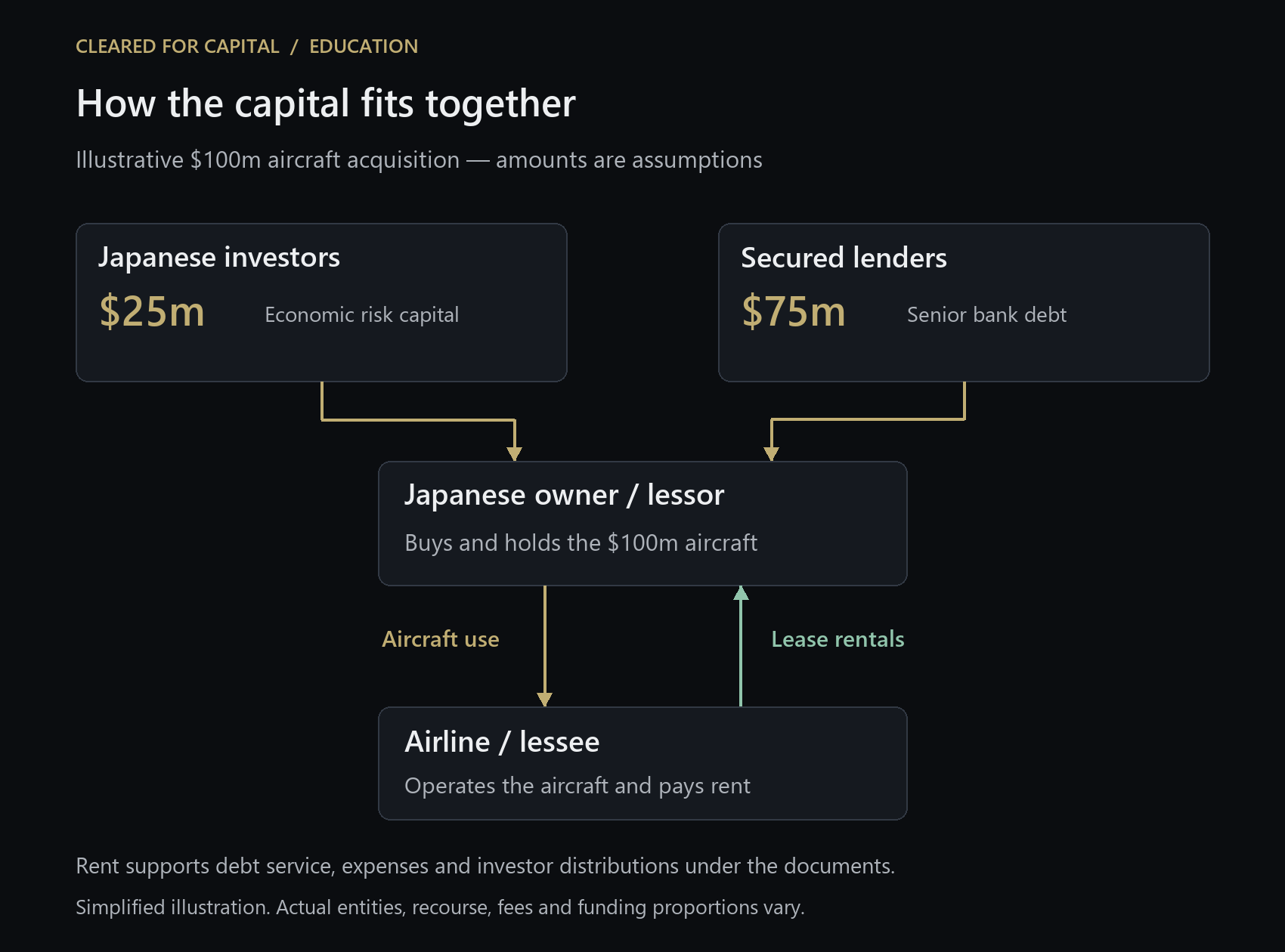
- A Japanese owner or lessor raises secured debt. Bank funding and investor contributions together fund the acquisition. A special-purpose entity holds the aircraft; investors generally do not operate it.
- The aircraft is acquired and leased. The airline takes operational use of the aircraft. More complex transactions can include intermediate lessors or subleases.
- The airline pays rentals. Those cash flows support debt service, transaction expenses and investor distributions according to the agreed arrangements.
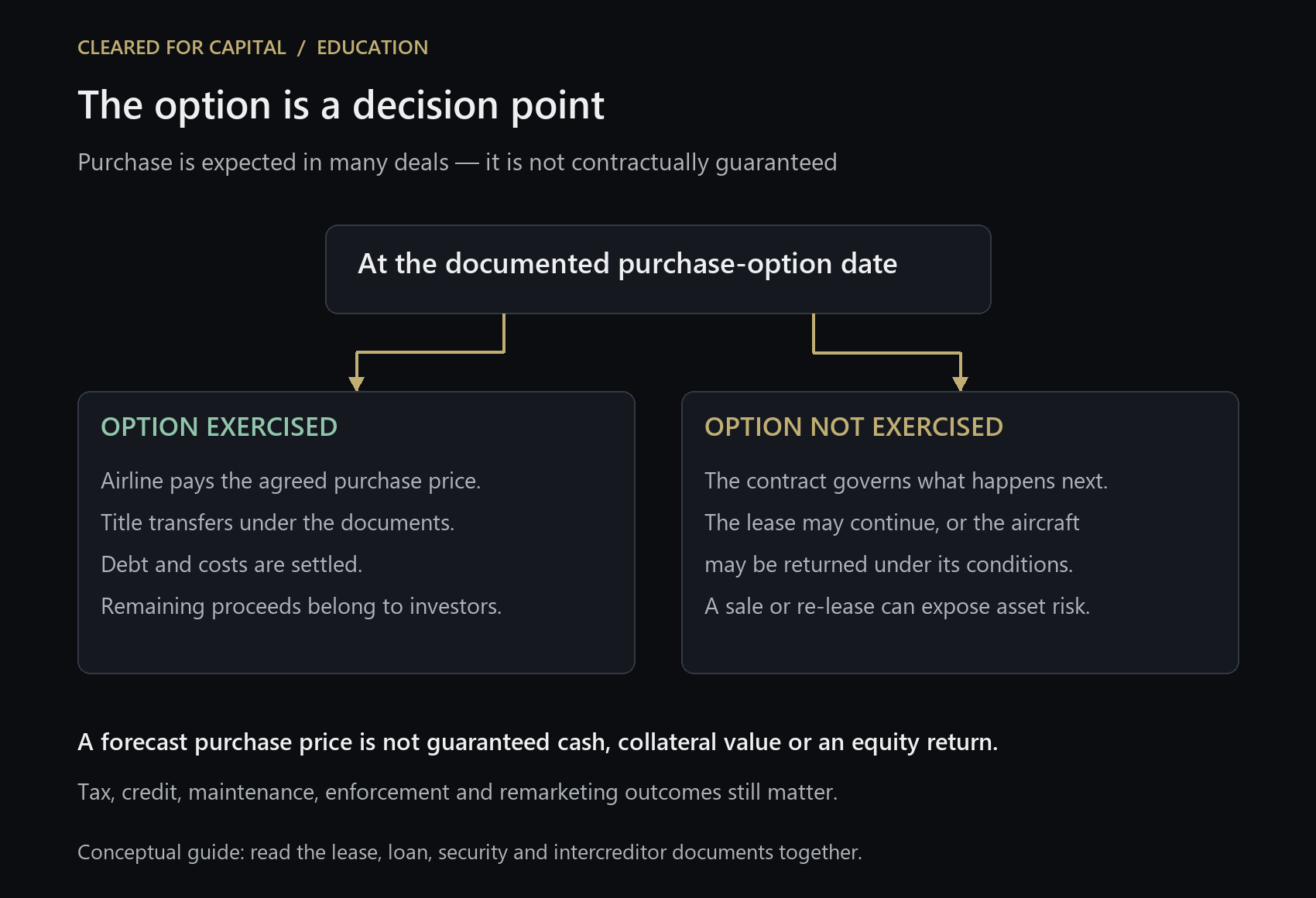
- A later purchase option provides a possible exit. If the airline exercises the option, title transfers through the contractual process. If it does not, the remaining lease and return provisions matter.
This is a simplified map. Mori Hamada & Matsumoto’s 2026 Japan guide explains the TK/NK structures and their legal distinctions; Reed Smith’s analysis of a documented JOLCO dispute illustrates how head leases, subleases and secured lending can interact.
What “100% financing” actually means
An airline may obtain funding for the full aircraft acquisition price without supplying that purchase-price equity itself. That does not mean a bank lends 100% of the aircraft’s value: Japanese investment capital fills part of the funding stack. NTT TC Leasing’s published model illustrates approximately 20–30% investor funding and 70–80% bank funding. Those are an arranger’s indicative proportions, not universal rules.
Our diagram uses a hypothetical $100 million aircraft funded with $25 million of Japanese capital and $75 million of debt. The arithmetic describes where the purchase money comes from; it says nothing about the interest rate, monthly rent, investor return or option price. When comparing offers, also ask which fees, deposits and pre-delivery payments are covered.
Why Japanese investors participate
The economic attraction includes the timing of taxable income. Aircraft depreciation and financing expenses can produce early tax losses; eligible investors may be able to use allocated losses against other taxable profits, subject to Japanese tax restrictions. Later profits and exit proceeds can create later tax liabilities. This is generally a tax-deferral mechanism, not a promise of permanently tax-free income. Holland & Knight’s aircraft-finance guide explains how part of that timing benefit can reach an airline through the transaction’s pricing.
Investor tax capacity, the relevant legal structure and recognition limits matter. A useful reading of a proposal therefore separates the aircraft’s commercial performance from the investor’s tax assumptions. A tax benefit does not repair an airline that stops paying rent. The 2026 Japan guide discusses those tax and structural limits.
The call option: expected does not mean guaranteed
The option normally permits a purchase on a specified date during the lease or at its end, at a price established when the deal is signed. That price is commonly structured around the anticipated future value of the aircraft. It should not be confused with today’s market value, an automatically nominal buyout, or an obligation that applies in every circumstance. JLPS sets out the option mechanics.
Many JOLCO models anticipate that the airline will exercise. The documentation and return economics can make that route attractive, but the distinction between a strong commercial incentive and a binding purchase commitment is fundamental. Pillsbury’s JOL/JOLCO discussion explains why the purchase option shapes the product.
JOLCO, JOL and an ordinary operating lease
A JOL also deploys Japanese investment capital, but typically leaves investors with greater exposure to the aircraft’s end-of-lease sale or re-lease value. A JOLCO adds the agreed purchase option and is usually evaluated around an expected airline acquisition. A conventional operating lease from an aircraft lessor commonly centres on rental income and a later return or remarketing, although the actual contract controls. Pillsbury compares the JOL and JOLCO risk profiles.
For the airline, the practical trade-off is funding cost versus flexibility. A JOLCO can support a long-term fleet plan, but changing the structure, extending the term or negotiating waivers may require several parties to agree. Compare the complete cash-flow and consent package with other financing offers. Holland & Knight identifies these flexibility constraints.
“Operating lease” does not mean off balance sheet
Japanese tax classification and an airline’s financial reporting answer different questions. Under IFRS 16, lessees generally recognise a right-of-use asset and a lease liability for leases longer than 12 months, subject to limited exemptions. A JOLCO label alone therefore does not establish off-balance-sheet treatment. Purchase options, the substance of the transaction and the applicable accounting framework still need analysis. The IFRS Foundation explains the lessee accounting model.
Where the risks remain
- Airline credit. Rental interruption affects the structure’s cash flow. Look through the brand to the actual lessee, any guarantor and their contractual obligations.
- Option and aircraft value. If the anticipated purchase does not occur, maintenance condition, records, return requirements and resale or re-lease value become critical.
- Currency and rates. The aircraft, debt, rent and investor contributions need not share a currency. Hedging changes the economics and can generate break costs; ask which party bears each exposure.
- Tax assumptions and fees. Investor eligibility, allowable losses, later tax charges and arrangement expenses can change the net result. Gross aircraft cash flows are not the investor’s net return.
- Control during distress. Lease defaults, loan defaults, lender transfers and enforcement rights need to be read together. A tidy transaction diagram cannot substitute for the documents.
NTT TC Leasing highlights asset-sale, currency and counterparty risks; FPG expressly warns that operating-lease investment principal and returns are not guaranteed. Reed Smith’s 2024 VietJet case analysis demonstrates why termination, transferee qualifications and enforcement provisions deserve close attention. These are structural lessons, rather than a statement about the current status of that litigation.
A real commercial-aircraft transaction
In July 2026, Norton Rose Fulbright reported advising MUFG on Viva Aerobus’ first JOLCO, supported by equity from Three i’s Capital. The financing related to an Airbus A321-271NX delivered in May 2026. It is a concrete example of airline credit, bank funding and Japanese capital being combined for a commercial aircraft. The disclosure is not a pricing benchmark.
Five questions to ask when reading a JOLCO announcement
- Who is the lessee, and who actually guarantees the payment obligations?
- What acquisition amount is funded, and which costs sit outside it?
- When can the option be exercised, at what price, and what happens otherwise?
- How do the rent currency, debt currency, hedging and investor tax assumptions interact?
- Who controls amendments, transfers, default remedies and the aircraft’s eventual exit?
A useful first reading treats JOLCO as a funding structure with an expected ownership pathway. Its attraction depends on how credit, asset value, tax timing and contract terms fit together. The purchase option is an essential part of that assessment.
Educational overview, prepared October 28, 2026. Transaction-specific tax, legal and accounting outcomes require specialist analysis. Illustrations are simplified and are not financing or investment quotations.
Continue reading: Where aircraft leasing sits in the business cycle · Aircraft ABS explained through two transactions